Conversational AI for customer service in 2026
Conversational AI for customer service explained: how it works, what Fin, Zendesk and Agentforce charge, and where it still fails. Compare the costs.
By Supun Bandara · September 28, 2026 · 15 min read

Conversational AI for customer service is software that answers customer questions in ordinary language, by chat, email or phone, and increasingly acts on them too: it can issue a refund, change a booking or cancel a subscription without a human agent. In 2026 it is sold by a handful of help desk and CRM vendors, and those same vendors write almost every guide that ranks for it. That is a problem when the question you actually need answered is what it costs and how often it gets things wrong.
This guide covers how the technology works, what the three best-known AI agents charge, how to read the resolution rates vendors advertise, and the public failures that should shape how you deploy it. Every price below was checked against the vendors' own pages in late September 2026.
What is conversational AI for customer service?
Conversational AI for customer service is a system that understands a customer's question in natural language, finds the answer in a company's own content and systems, replies in plain language, and hands the conversation to a person when it cannot help. The newer versions, usually sold as AI agents, can also complete tasks such as refunds and account changes.
Under the hood, most products in 2026 combine five parts:
Language understanding. Working out what the customer wants, even when the question is misspelled, vague or split across several messages.
A large language model. The part that writes the reply. It is the same kind of model that powers general assistants, and our comparison of ChatGPT, Claude and Gemini covers how the leading ones differ.
Retrieval. Pulling the relevant help articles, policy text and order history into the conversation, so the answer comes from the company's content rather than the model's general knowledge.
Actions. Connections to billing, order or booking systems, so the AI can do something rather than describe how to do it.
Handoff. Passing the conversation, with its history, to a human agent.
Older chatbots had little more than the first part, matched against a script. The jump in quality since 2023 comes almost entirely from the second and third.
Conversational AI vs. chatbots vs. AI agents
A chatbot is any automated chat interface. Conversational AI is the subset that understands free-form language instead of menus and keywords. An AI agent is conversational AI that can also take actions in other systems. Vendors use all three terms loosely, so ask what a product can do rather than what it is called.
Type | How it answers | Takes actions? | Good at | Typical failure |
|---|---|---|---|---|
Rule-based chatbot | Menus and keyword matching against scripted flows | Only scripted ones | Order status, opening hours | Dead ends when the question is off-script |
Phone menu (IVR) | Recorded prompts, keypad or simple speech | A few, such as a balance lookup | Routing calls | Loops that end in "press 0" |
Generative chatbot | Writes answers from the company's knowledge base | No | Policy and how-to questions | Fluent, confident, wrong answers |
AI agent | Writes answers and calls other systems | Yes: refunds, cancellations, account changes | Fixing the problem end to end | The wrong action, or the right action for the wrong customer |
The shift toward agents is why the whole market has renamed its products. In March 2025, Gartner predicted that agentic AI will autonomously resolve 80% of common customer service issues without human intervention by 2029, leading to a 30% reduction in operational costs. That is a forecast, not a measurement, and it refers to common issues rather than all of them.
How it works, step by step
A single conversation with a modern AI agent usually runs through six steps:
The customer asks. Typed text goes straight in; a phone call is transcribed to text first.
The system works out the intent and any details it needs, such as an order number, an email address or the product involved.
It retrieves the relevant material: help articles, policy pages, the customer's account and order history.
A language model drafts the reply from that material, under instructions about tone, what it may promise and which topics it must not touch.
If it is allowed to act, it calls the relevant system, for example issuing a refund below a set limit.
It checks whether the customer is satisfied and hands off to a person, with the conversation history, if not, or if a rule fires: the customer asks for a human, or the topic is on a list the AI must not handle.
Step 3 is where most quality problems begin. A model answering from a stale or contradictory help center will repeat the contradiction fluently. The best-known chatbot court case, covered below, turned on an answer that another page of the company's own website contradicted.
What conversational AI can realistically handle
It performs best on questions that are frequent, answerable from written policy or account data, and low in judgment. It performs worst where a wrong answer creates a promise, a cost or a distressed customer.
Order, account and status questions
"Where is my order", password resets, address changes and plan details make up much of a typical support queue, and they are the natural first target. The most cited early deployment is Klarna's. In its February 2024 announcement, the payments company said its AI assistant handled 2.3 million conversations in its first month, two-thirds of its customer service chats, and cut the average time to resolve an errand from 11 minutes to under 2. Klarna also reported a 25% drop in repeat inquiries. Those are the company's own figures, and the story did not end there.
Troubleshooting from documentation
Step-by-step fixes work well when the documentation is current and specific. When it is not, the AI fills the gaps with plausible guesses. Cleaning up the help center is usually the most useful work a team can do before switching anything on.
After-hours and multilingual support
This is where the economics are hardest to argue with. Klarna said the same assistant ran around the clock in 23 markets and more than 35 languages, coverage that would take a large human team to match.
What it should not handle alone
Billing disputes, complaints, cancellations with retention offers, bereavement and anything involving a vulnerable customer all need a clear route to a person. Customers expect one. A Gartner survey of 3,566 customers, run in February and March 2026, found that 87% say companies using generative AI for customer service must provide access to a human agent.
How much does conversational AI cost?
In late September 2026 the three best-known AI agents each charge in a different unit. Fin charges $0.99 per outcome. Zendesk bills per automated resolution, drawn from a dollar allowance. Salesforce's Agentforce charges either $2 per conversation or $0.10 per action. The unit matters more than the headline number, because it decides who pays when the AI fails.
Three ways to be billed
Per resolution or outcome. You pay only when the AI finishes the job. The risk of a weak bot sits with the vendor, so long as its definition of "resolved" is a fair one.
Per conversation. You pay every time the AI engages, resolved or not. The risk of a weak bot sits with you.
Per action. You pay for each step the agent takes, such as a lookup or a record update. Short conversations are cheap; long ones are hard to predict.
On top of all three, most vendors still charge per human agent seat for the help desk itself.
Product | Billing unit | Listed price | What else you pay |
|---|---|---|---|
Fin | Per outcome, at most one per conversation | $0.99 | A 50-outcome monthly minimum when used with another company's help desk |
Zendesk AI agents | Per automated resolution, drawn from a dollar allowance | Not published; reported at $1.50 committed, $2.00 pay-as-you-go | Suite seats from $55 per agent a month, billed yearly |
Agentforce (Conversations) | Per conversation | $2.00 | Salesforce licenses |
Agentforce (Flex Credits) | Per action | $0.10 (20 credits, sold at $500 per 100,000) | Salesforce licenses |
Sources: Fin pricing, Salesforce's Agentforce pricing article, Zendesk pricing and its resolution allowance documentation.
Zendesk is the awkward one. Its pricing page says AI agents are included in every plan and priced on outcomes, and its documentation says each plan comes with a monthly allowance in dollars: $2 per agent seat on Team, $5 on Growth and Professional, $10 on Enterprise, capped at $5,000 a year. What it does not publish is the price of a single resolution. The $1.50 and $2.00 figures come from Fin's own pricing comparison, which is a competitor's account, so confirm them with Zendesk before you budget on them.
A worked example: 5,000 conversations a month
Take a support team whose AI handles 5,000 conversations a month and resolves 60% of them, or 3,000, without a human. For the Flex Credits line, assume the agent takes four actions per conversation. At list prices, the AI part of the bill looks like this:
Product and model | Calculation | Monthly bill | Cost per resolved conversation |
|---|---|---|---|
Fin | 3,000 × $0.99 | $2,970 | $0.99 |
Zendesk, committed | 3,000 × $1.50 | $4,500 | $1.50 |
Zendesk, pay-as-you-go | 3,000 × $2.00 | $6,000 | $2.00 |
Agentforce, per conversation | 5,000 × $2.00 | $10,000 | $3.33 |
Agentforce, Flex Credits | 5,000 × 4 × $0.10 | $2,000 | $0.67 |
The last column is the one to watch, because it is the only one that moves with the quality of the bot. Under per-resolution pricing, a bot that resolves 40% of conversations costs the same per fix as one that resolves 80%. Under per-conversation pricing, every failed conversation is still billed, so the cost per fix rises as quality falls: $5.00 at a 40% resolution rate, $2.50 at 80%.
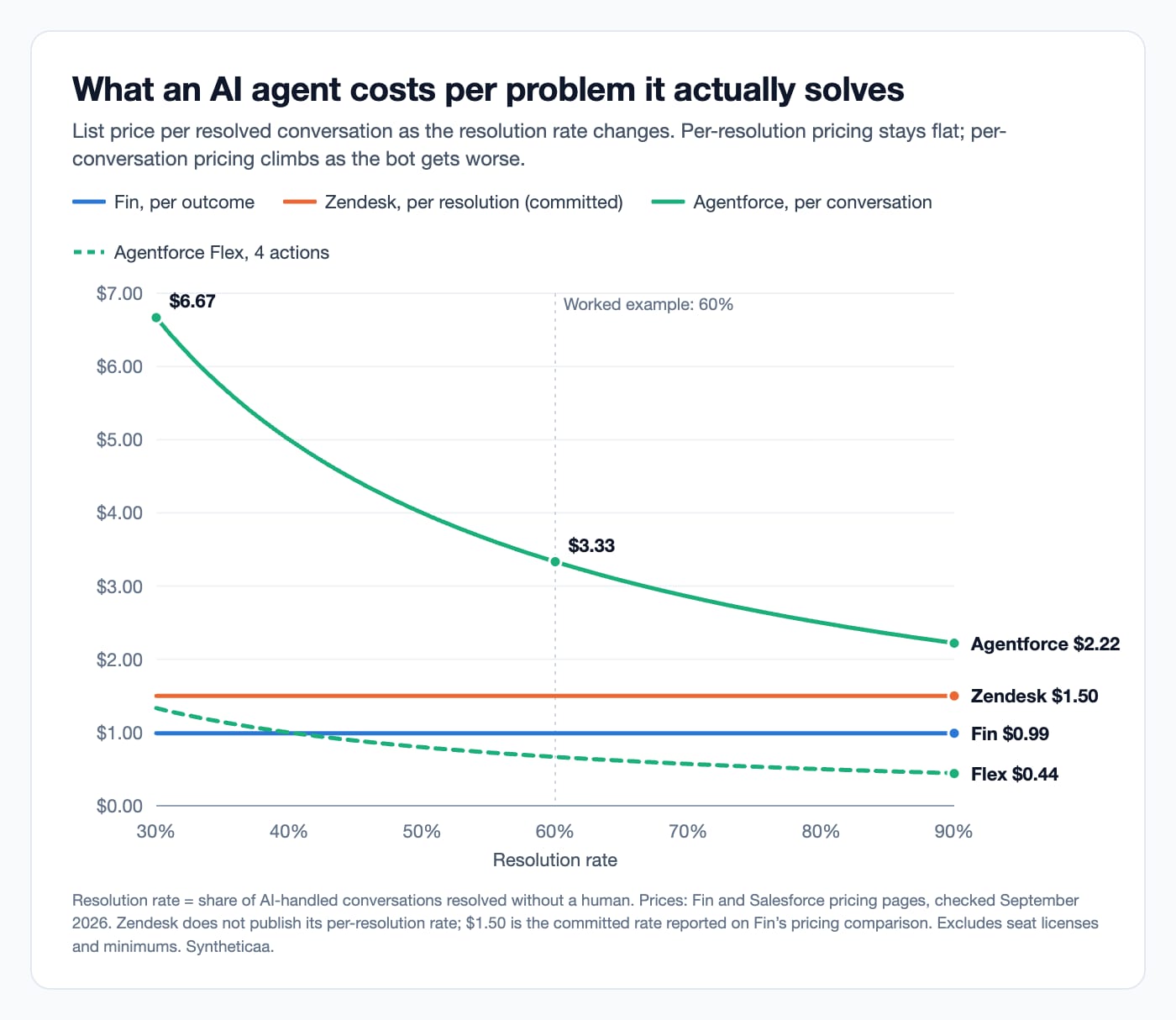
Flex Credits look cheapest here, but only because four actions is a modest assumption. At 20 actions a conversation, Flex costs the same $2 as the per-conversation plan, and the number of actions depends on how the agent is built, which is hard to know before launch. Fin's bill can also run above the resolution count: its pricing page lists other billable outcomes, including some handoffs to human agents and routing. The same problem of vendors pricing in incompatible units runs through AI coding assistant plans, and the fix is the same: convert everything to a cost per result before comparing.
Two of these products now have the same owner
On September 10, 2026, Salesforce completed its acquisition of Fin, the company formerly called Intercom, in a deal valued at about $3.6 billion. Salesforce now sells both a per-outcome product and a per-conversation one. Fin's pricing page still listed $0.99 per outcome at the end of September, but anyone signing a multi-year contract with either product should get the billing unit, not just the rate, written into it. The cost of running the models underneath is moving too, as we covered in the AI race turning into an electricity race.
Resolution rates, and why vendor numbers do not compare
A resolution rate is only as meaningful as the definition behind it, and each vendor writes its own. Salesforce says Fin achieves an average resolution rate of 76%. Nobody can compare that with a figure from another vendor without knowing what each one counts.
Product | What counts as resolved | When it is judged |
|---|---|---|
Fin | "No further help is requested after Fin's last answer" | At the end of the conversation |
Zendesk | Resolved by the AI agent without escalation to a human; only the "verified resolution" tier counts against the allowance | Email: 72 hours after the first email. Messaging: 2 hours after the last message by default, up to 72. Voice: at hang-up |
Agentforce (Conversations) | Not needed for billing: every conversation is charged | Not applicable |
Sources: Fin pricing, Zendesk automated resolution tiers.
Definitions like these count silence as success. A customer who gave up, or who got a wrong answer and did not come back, can look exactly like a resolved one. Three terms get blurred in vendor reports, and they are worth separating:
Deflection: the customer did not reach a human. They may have been helped, or they may have left.
Containment: the conversation stayed inside the bot from start to finish.
Resolution: the customer's problem was solved. This is the only one that matters, and the hardest to verify.
The practical check is cheap: every month, pull a random sample of 100 conversations marked as resolved and read them. The share that were genuinely solved is your real resolution rate, and it is the number to hold a vendor to.
Where conversational AI goes wrong
The public failures so far share a pattern. The AI was given authority, stated something false with total confidence, and the company was held to it.
Air Canada: the chatbot's answer was binding
In February 2024, British Columbia's Civil Resolution Tribunal ruled against Air Canada in Moffatt v. Air Canada. The airline's website chatbot had told a grieving passenger he could apply for a bereavement fare after traveling, which another page of the same website contradicted. Air Canada argued the chatbot was, in the tribunal's summary, "a separate legal entity that is responsible for its own actions." The tribunal called that "a remarkable submission" and wrote: "It should be obvious to Air Canada that it is responsible for all the information on its website. It makes no difference whether the information comes from a static page or a chatbot." The airline was ordered to pay C$650.88 in damages, about C$812 with interest and fees. The ruling is Canadian and binds no US court, but its reasoning is the one any company should plan around.
Cursor: an invented policy
In April 2025, users of the AI code editor Cursor who kept getting logged out asked support why. An AI support agent signing its emails "Sam" told them it was a new policy limiting subscriptions to one device. No such policy existed; the logouts came from a session bug. Users cancelled subscriptions before co-founder Michael Truell responded: "We have no such policy. You're of course free to use Cursor on multiple machines." The company refunded the affected user and now labels AI-written email support replies as AI.
Klarna: cost first, quality second
Fifteen months after announcing that its assistant handled two-thirds of chats, Klarna changed course. Chief executive Sebastian Siemiatkowski told Bloomberg in May 2025, as reported by CX Dive: "As cost unfortunately seems to have been a too predominant evaluation factor when organizing this, what you end up having is lower quality." Klarna began recruiting human agents on flexible schedules for complex cases, while the AI kept handling routine ones.
The hidden-human problem
Customers' objection is less to AI itself than to AI standing between them and a person. In a Gartner survey of 5,728 customers conducted in December 2023, 64% said they would prefer companies did not use AI for customer service, and 53% said they would consider switching to a competitor over it. The top concern, cited by 60%, was that AI would make it harder to reach a human. Gartner's 2026 survey, where 87% say a human must stay reachable, suggests attitudes have softened toward the AI but not toward the wall.
What to check before choosing a platform
Most of the failures above were preventable at the buying stage. Before signing, get clear answers to these:
The billing unit, in writing. Ask for the exact definition of a billable resolution, outcome or conversation, and which other events are billed.
How resolutions are verified. Can you see which conversations were counted, and dispute the ones that were not really solved?
The route to a human. One step, available at any point, with the conversation history carried over so the customer does not repeat themselves.
Grounding and off-limits topics. Can you restrict answers to your own content, and block topics such as refund promises, legal questions and pricing exceptions?
Limits on actions. Refund caps, confirmation steps and an audit log of every action the agent took.
Conversation-level reporting. Transcripts you can sample, not just a dashboard percentage.
Disclosure. California's SB 1001, in force since July 2019, makes it unlawful to use a bot that misleads people about being a bot in order to sell to them, unless it is disclosed. Utah and Maine have since passed their own AI disclosure rules, and more states added chatbot laws in 2026. The simple approach, the one Cursor landed on, is to label the AI as AI everywhere.
Contract protection. Price protection and a clean data export, which matter more in a market that is consolidating.
FAQ
Will conversational AI replace human support agents?
Not entirely, on current evidence. Klarna, the most cited example of replacing agents with AI, began hiring people again in 2025. Gartner's forecast is that agentic AI will handle 80% of common issues by 2029, which still leaves the uncommon, high-stakes cases, and the customers who insist on a person, to humans.
Is conversational AI the same as ChatGPT?
No. ChatGPT is a general assistant. Customer service AI often runs on similar language models but is connected to one company's help content, customer records and systems, and is restricted in what it may say and do.
How long does it take to set up?
A bot that only answers from your help center can be running quickly if that content is current. The time goes into cleaning up contradictory articles, connecting the systems it needs for actions, and testing handoffs, and that work scales with how many actions you want it to take.
Is it worth it for a small business?
It can be, when most incoming questions are repetitive and answerable from written policy. Fin's 50-outcome minimum works out to a $49.50 monthly floor when paired with another help desk, and Zendesk plans include a small allowance. If most of your contacts need judgment, a well-organized help center may do more for less.
The bottom line
Conversational AI now resolves a meaningful share of routine customer service work, and the vendors selling it are consolidating fast. The choices that decide whether it works for you are unglamorous: pick a billing unit that leaves the risk of failure with the vendor, insist on a definition of "resolved" you can audit, and never make a human hard to reach. For more on the AI tools reshaping everyday work, see our technology coverage.
Keep reading

AI coding assistant pricing compared in 2026
AI coding assistant pricing compared for 2026: Copilot, Cursor, Claude Code and Codex, with what each plan's included usage is actually worth in dollars.
Supun BandaraSeptember 4, 202610 min read
Password Managers: Are They Safe in 2026?
Are password managers safe? What the LastPass breach really exposed, the settings that decide whether your vault holds, and where passkeys fit in 2026.
Supun BandaraSeptember 3, 202611 min read

UK Laptop Prices Autumn 2026: Buy Now or Wait?
UK laptop and PC prices are climbing as AI data centres soak up memory. Here is what is driving it, what to expect by Black Friday, and whether to buy now.
Supun BandaraSeptember 3, 20268 min read