AI coding assistant pricing compared in 2026
AI coding assistant pricing compared for 2026: Copilot, Cursor, Claude Code and Codex, with what each plan's included usage is actually worth in dollars.
By Supun Bandara · September 4, 2026 · 10 min read

The sticker prices, side by side
Here is what the four main AI coding assistants charge individual developers per month, as listed on their own pricing pages in September 2026. All figures are in US dollars and exclude tax. This post is about cost alone, so if you are still deciding which tool suits your work, start with our comparison of the best AI coding assistants and what each one is good at and come back here to price it.
Tool | Free | Entry | Mid | Top |
|---|---|---|---|---|
GitHub Copilot | Free | Pro $10 | Pro+ $39 | Max $100 |
Cursor | Hobby | Pro $20 | Pro+ $60 | Ultra $200 |
Claude Code | Not included | Pro $20 ($17 annual) | Max 5x, from $100 | Max 20x |
OpenAI Codex | Free | Go $8 · Plus $20 | Pro 5x, from $100 | Pro 20x $200 |
Claude Code has no separate price and is bundled into every paid Claude plan. Codex is bundled into ChatGPT the same way. Claude's free plan is the one exception in the table: it does not include Claude Code at all.
That list is where most comparisons stop, and it is close to useless on its own. Copilot Pro at $10 and Cursor Pro at $20 are not the same product at half the price. What separates them is the included usage behind the fee, and each vendor measures that in a different unit.
Four vendors, four incompatible units
This is the part that makes a like-for-like comparison genuinely hard, and it is worth understanding before you pick a tier. Only one of the four publishes its allowance in money.
Tool | Unit of account | Convertible to dollars? | What you can work out |
|---|---|---|---|
GitHub Copilot | AI credits, 1 credit = $0.01 | Yes, published | The exact dollar value of every allowance |
Cursor | Multiples of Pro ("3x", "20x") | No | Nothing from the page; Cursor publishes usage estimates instead |
Claude Code | Multiples of Pro, per 5-hour session | No | Nothing; the pool is shared with chat |
OpenAI Codex | Credits per million tokens | No, credit price unpublished | The credit cost of a given task, but not its price |
GitHub prices its allowance in dollars
Copilot moved to usage-based billing in June 2026. Usage is metered in GitHub AI Credits, and GitHub's billing documentation fixes one credit at $0.01. Each paid plan gets base credits matching the subscription price plus a variable "flex allotment" on top:
Pro at $10: 1,000 base plus 500 flex, so 1,500 credits, worth $15.
Pro+ at $39: 3,900 plus 3,100, so 7,000 credits, worth $70.
Max at $100: 10,000 plus 10,000, so 20,000 credits, worth $200.
Credits do not roll over: GitHub's wording is that unused credits "are forfeited". The allowance resets at 00:00:00 UTC on the first day of each calendar month, regardless of when your billing date falls. Code completions and next edit suggestions are not billed in credits at all and stay unlimited on every paid plan.
Cursor splits usage into two pools and describes them as multiples
Cursor's pricing page no longer publishes a dollar figure for included usage. Pro+ is described as 3x Pro limits on Agent, Ultra as 20x, and Teams Premium as 5x Standard. Its models documentation explains the structure: there are two pools, one for Cursor's own models (Grok 4.6 and Grok 4.5 at $2 per million input tokens, Composer 2.5 at $0.50) and one for third-party models charged at each model's API rate. The plan table marks both pools as simply "Included."
Cursor does publish the most useful budgeting guidance of any vendor, though. Its pricing documentation estimates that daily agent users typically run "$60–$100/mo total usage", and that power users running multiple agents or automations are "often $200+/mo".
Claude Code sells multiples of Pro, measured per session
Claude Code has no separate price. It is bundled into every paid Claude plan and draws from the same usage pool as chat, so a heavy day in the web app eats into your terminal budget. Anthropic's pricing page describes limits as multipliers on a rolling five-hour session window, with weekly limits stacked on top: Pro gives at least 5x Free per session, Max gives 5x or 20x Pro. When you hit a limit you can wait for the reset, upgrade, or switch on usage credits and keep working at standard API rates.
Codex prices in credits, but not in dollars
OpenAI meters Codex in credits per million tokens. The Codex pricing documentation publishes a full rate card, and the spread across it is wide:
Model | Credits per M input | Credits per M output | Sol messages per 5-hour window, Plus |
|---|---|---|---|
GPT-6 Astra | 250 | 1,250 | 5–45 |
GPT-5.6 Sol | 100 | 500 | 10–100 |
GPT-5.6 Terra | 50 | 300 | 25–200 |
GPT-5.6 Luna | 5 | 30 | 250–2,000 |
On Pro 20x those message estimates multiply by twenty, so Sol runs 200 to 2,000 messages per window. What the page does not publish is what a credit costs. The docs say credit purchase prices and discounts "depend on your plan or agreement". So unlike GitHub's credits, you cannot convert a Codex allowance into dollars from the pricing page alone.
Doing the arithmetic anyway
Two of these units can be turned into money with published numbers, which is as close to a fair comparison as the market currently allows.
For Copilot, the conversion is direct. Pro+ gives you $70 of credits for a $39 fee. As a scale check, Anthropic lists Claude Opus 5 at $5 per million input tokens and $25 per million output. Spent entirely one way, $70 is roughly 14 million input tokens or 2.8 million output tokens. Real agent sessions land somewhere between those two figures, and GitHub prices each model against its own published rate card, so treat this as an order of magnitude rather than a quote.
For Codex, you can price a task in credits even without the dollar conversion. A session that pulls in 200,000 tokens of context on GPT-5.6 Sol and writes 30,000 tokens of output costs 20 credits for input and 15 for output, so 35 credits total. Run the same session on GPT-6 Astra and it costs 50 plus 37.5, or 87.5 credits, two and a half times as much for one model change.
For Cursor and Claude Code, no equivalent sum is possible from the pricing pages. You buy a multiple of a tier you have not measured yet, which means the only reliable method is to run a tier for two full billing cycles and read the usage dashboard.
The upgrade nobody mentions is free
There is one number that barely moves across all four tools: the cost of ordinary autocomplete. Copilot's completions and next edit suggestions are unlimited and unmetered on every paid plan. Cursor includes unlimited tab completions from Pro upward. If you use these tools mainly as smart autocomplete, the cheapest paid tier will last you indefinitely and the entire pricing debate is irrelevant to you.
Everything expensive is agentic. Chat, agent mode, code review, CLI sessions and cloud agents are what consume credits, and a single agent run across a large codebase can involve dozens of model calls. Model choice compounds it: Cursor's rate card puts Claude Fable 5.1 at $10 per million input tokens against $0.75 for Gemini 3.8 Flash, a thirteenfold spread for the same request. Routing routine edits to a cheaper model is a bigger lever than any plan change, and our breakdown of how ChatGPT, Claude and Gemini differ in practice covers which jobs are safe to hand to the cheap tier.
Team seats: what you are actually buying
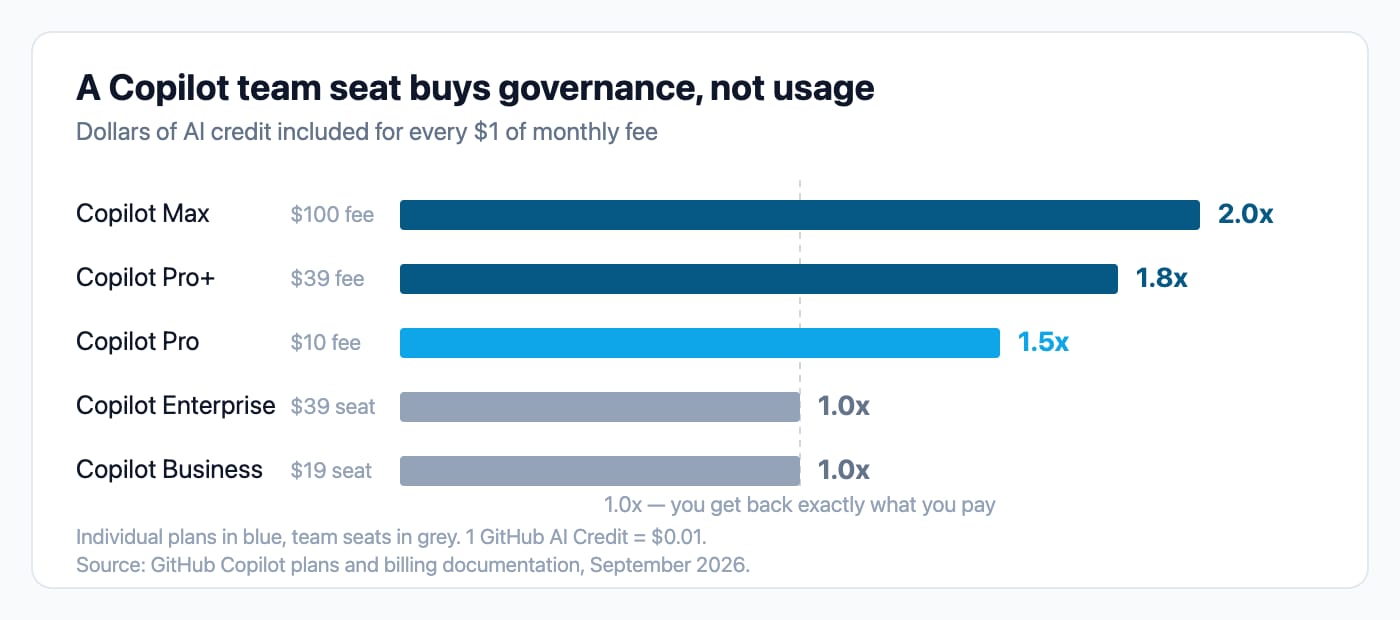
At team scale the seat price stops being the interesting number. Set the fee against the usage it buys and the individual plans look quietly better.
Plan | Monthly fee | Credits included | Dollar value | Return per $1 |
|---|---|---|---|---|
Copilot Pro | $10 | 1,500 | $15 | 1.5x |
Copilot Pro+ | $39 | 7,000 | $70 | 1.8x |
Copilot Max | $100 | 20,000 | $200 | 2.0x |
Copilot Business | $19 per seat | 1,900 | $19 | 1.0x |
Copilot Enterprise | $39 per seat | 3,900 | $39 | 1.0x |
Both business tiers return exactly what you pay, while every individual tier returns more. The business seat is not buying you more usage per dollar. It is buying policy control, pooled credits and central administration: GitHub pools each licence's credits at the billing entity level, so an enterprise with 100 Business users draws on one shared bucket of 190,000 credits rather than a hundred separate ones.
The other vendors price seats without a comparable conversion. Cursor Teams is $40 per user for Standard and $120 for Premium with 5x Standard agent limits. Claude Team is $20 per seat on annual billing ($25 monthly) for Standard and $100 annual ($125 monthly) for Premium with 5x Standard usage, and seat types can be mixed on one account. ChatGPT Business is $20 per user on annual billing ($25 monthly), with a minimum of two users.
Cursor adds a charge that only appears at team scale: a Cursor Token Rate of $0.25 per million tokens on third-party model requests, applied on top of the model's API price. It is charged on included usage, on-demand usage and bring-your-own-key usage alike, so supplying your own API key does not avoid it. Opting into regional data residency adds a further 10% on eligible models.
Which tier fits which developer
How you work | What to buy | Why |
|---|---|---|
Mostly autocomplete, occasional chat | Copilot Pro $10 or Cursor Pro $20 | Completions are unmetered, so you will rarely touch the ceiling |
Daily agent use on one project | Cursor Pro+ $60, Copilot Pro+ $39, or Claude Pro $20 | Cursor's own $60–$100 estimate points here; Copilot Pro+ returns $70 of credits for $39, and Claude Pro suits bursty sessions |
All day, multiple agents | The $100–$200 tiers | Cursor Ultra, Copilot Max, Claude Max and Codex Pro all sit in this band, and nothing below them will hold |
Learning, not shipping yet | Free tiers | None of these subscriptions teaches you anything a free plan will not |
A team | Individual plans first, seats later | Watch two billing cycles, then buy seats for the people who need governance rather than for everyone at once |
On the last row: every one of these vendors lets you mix seat types, so a staged rollout costs nothing. And if you are still training rather than shipping, the money is better spent elsewhere, as our look at what a coding bootcamp costs against its job outcomes sets out.
FAQ
Is Claude Code sold separately from Claude?
No. It is included in all paid Claude plans and shares one usage pool with chat on web, desktop and mobile. There is also a pay-as-you-go route through the API if you would rather not subscribe.
What happens when I run out of included usage?
It depends on the meter. Copilot's credits reset on the first of the calendar month, and you can set a dollar budget to keep working at $0.01 per credit. Cursor bills on-demand usage in arrears at the same rates. Claude and Codex reset on rolling five-hour windows, so you may only need to wait, and both let paid users buy additional usage.
Which is cheapest overall?
For autocomplete-only work, Copilot Pro at $10. For agent-heavy work, the honest answer is that nobody can tell you without your usage data, because three of the four vendors do not publish included usage in a unit you can convert to money.
Do the free tiers do anything useful?
They are enough to evaluate. Copilot Free includes limited chat and agent usage, Cursor Hobby gives limited agent requests and Composer access with no card required, and Codex has limited free access. Claude's free plan is the exception, as it does not include Claude Code.
Does a team seat get me more usage than an individual plan?
On Copilot, no. A Business seat at $19 returns $19 of credits, a flat 1.0x, while Pro returns 1.5x and Max 2.0x. What the seat buys is policy control, pooled credits and central administration.
Before you subscribe
Pricing in this category changed several times in 2026, including Copilot's move to token-based credits in June and a cut to ChatGPT Business seats in April. Every figure above was checked against the vendors' own pages in September 2026, and every one of those pages is worth opening before you pay, because plan names, credit allowances and model rate cards all move faster than the comparison articles that cover them.
If you are choosing right now, the practical sequence is unchanged: run the cheapest paid tier for two full billing cycles, read your usage dashboard, and let the measured number pick the plan.
Keep reading

AI in healthcare 2026: uses, costs, evidence
AI in healthcare by the numbers: who uses it, what ambient scribes cost, how many devices the FDA lists and where it has fallen short. See the data.
Supun BandaraOctober 10, 202617 min read

Conversational AI for customer service in 2026
Conversational AI for customer service explained: how it works, what Fin, Zendesk and Agentforce charge, and where it still fails. Compare the costs.
Supun BandaraSeptember 28, 202615 min read

Password Managers: Are They Safe in 2026?
Are password managers safe? What the LastPass breach really exposed, the settings that decide whether your vault holds, and where passkeys fit in 2026.
Supun BandaraSeptember 3, 202611 min read