AI in healthcare 2026: uses, costs, evidence
AI in healthcare by the numbers: who uses it, what ambient scribes cost, how many devices the FDA lists and where it has fallen short. See the data.
By Supun Bandara · October 10, 2026 · 17 min read

AI in healthcare is software that learns patterns from medical data and uses them to do work people used to do by hand: reading scans, drafting clinical notes, coding bills, flagging patients at risk and answering patient questions. In 2026 most of it handles paperwork, not diagnosis. Many of the figures in circulation come from vendors and investors.
This guide puts the numbers in one place: who uses AI, where the money goes, what an AI scribe costs, what independent researchers have measured, and how the tools are regulated. Every figure is dated, linked to its source and was checked on October 10, 2026. The author is a data analyst, not a clinician. This is a report on technology and markets, not medical advice.
Key takeaways
- In early 2026, 72% of US physicians said they use at least one AI tool in their practice, up from 38% in 2023. The widely quoted 81% includes physicians who are unsure what their practice offers.
- The FDA's list of AI-enabled medical devices held 1,614 entries when we counted it. Radiology accounts for 76% of them, and 96% were cleared through the 510(k) route.
- Healthcare organizations spent an estimated $1.4 billion on AI in 2025, and $600 million of that went to ambient scribes.
- Freed, a self-serve vendor that publishes its prices, charges $39 a month for up to 40 notes and $104 to $119 for its top plan. Health-system contracts are estimated at $300 to $500 per clinician per month.
- An observational study of 8,581 clinicians measured 16 fewer minutes of documentation per eight hours of scheduled patient care.
- The documented problems are specific: a sepsis model that missed 67% of cases in one health system's validation, a transcription model that invented text in about 1% of recordings, and a vendor accuracy claim the Texas Attorney General alleged was likely inaccurate (the company denied wrongdoing).
What is AI in healthcare?
AI in healthcare (artificial intelligence in healthcare), also called healthcare AI or medical AI, is an umbrella term for four fairly different kinds of software. They take in different data, produce different outputs and fail in different ways, so it helps to separate them before looking at any numbers.
| Type | What it does | A healthcare job it does | Typical failure |
|---|---|---|---|
| Prediction models (machine learning) | Scores risk from patient records | Flagging likely sepsis or readmission | False alarms and missed cases |
| Computer vision | Finds patterns in images | Marking suspicious areas on a mammogram | Missed findings, or readers who lean on it too much |
| Speech and language AI | Turns conversation into structured text | Ambient scribes that draft the visit note | Omitted or invented details |
| Generative AI (large language models) | Writes, summarizes and answers questions | Summarizing a chart or drafting a reply to a patient | Fluent, confident, wrong answers |
Prediction and imaging software have been in hospitals for years. The newer money has gone to the last two: ambient documentation alone took $600 million of 2025 spending in one investor's estimate, covered below.
How widely is AI used in healthcare?
Widely, but the answer depends on who is asked and what counts as use. Five statistics give the clearest picture for 2026, and each one measures something different.
| Measure | Figure | Period | Source | What it counts |
|---|---|---|---|---|
| Physicians using AI | 72% | January to February 2026 | AMA survey of 1,692 physicians | Physicians who named at least one AI use in their practice |
| Hospitals using predictive AI | 71% | 2024 | ASTP Data Brief No. 80 | US non-federal acute care hospitals with predictive AI built into the health record system |
| Organizations with AI tools | 22% | 2025 | Menlo Ventures survey of 700+ executives | Healthcare organizations that have implemented domain-specific AI tools |
| AI spending | $1.4 billion | 2025 | Menlo Ventures | Estimated healthcare AI spend, nearly triple 2024 |
| FDA-listed AI devices | 1,614 | Decisions to June 29, 2026 | FDA list, our count | Devices the FDA has identified as AI-enabled |
The physician figure needs a footnote. The American Medical Association's headline is that more than 80% of physicians use AI professionally, and its report gives 81%. The chart behind that number splits it in two. Some 72% incorporate one or more AI uses into their practice, and another 9% are uncertain which AI tools their practice offers. The 72% is the like-for-like figure, and it has still nearly doubled from 38% in 2023.
Adoption is also uneven. In the federal hospital data, 86% of hospitals that belong to a multi-hospital system used predictive AI in 2024, against 37% of independent hospitals. One caution on the spending figure: Menlo Ventures is a venture capital firm, so $1.4 billion is an investor's survey-based estimate, not an audited total.
Where healthcare AI is used today
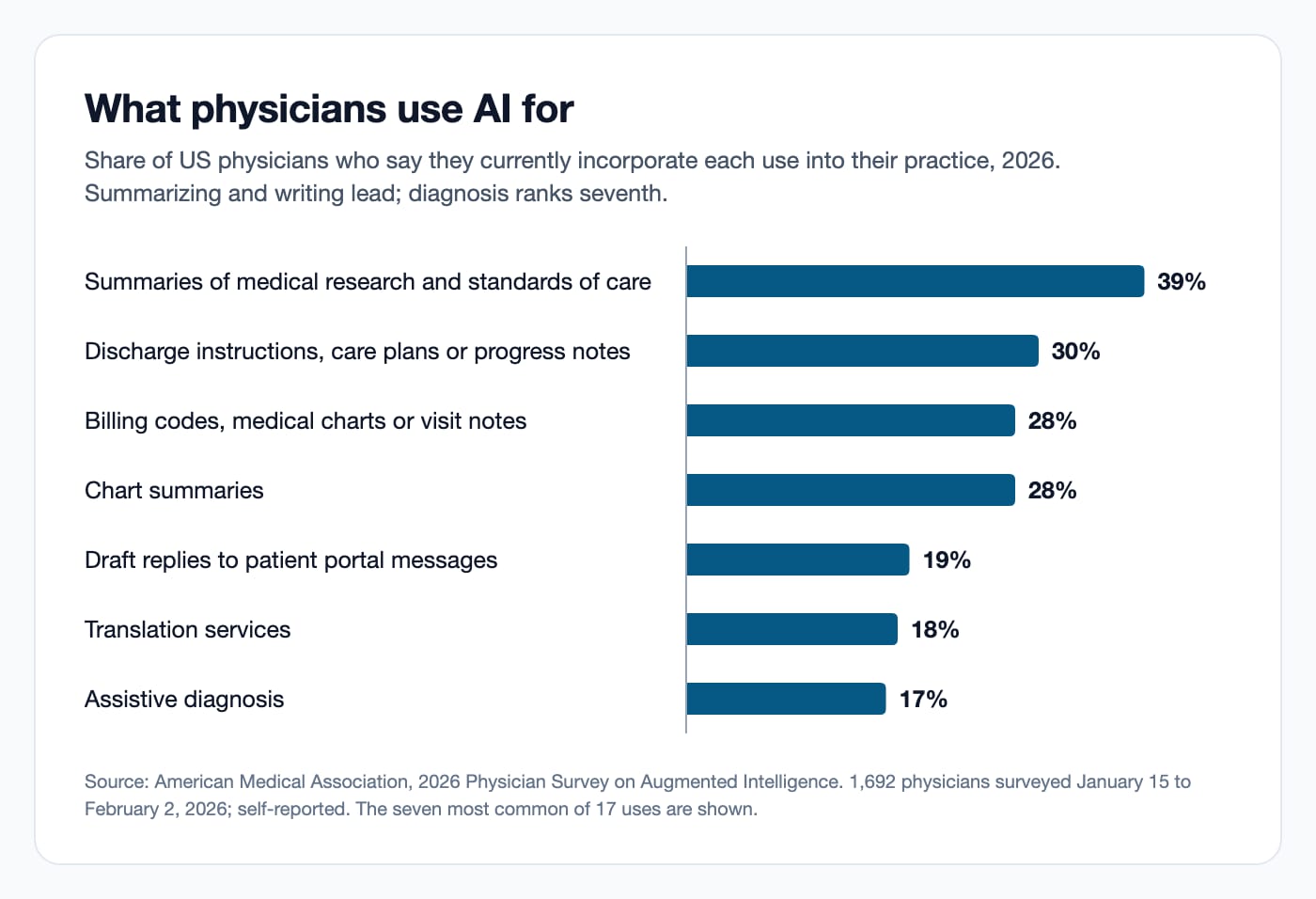
The popular image of medical AI is a machine that diagnoses. Most of the use is administrative. In the AMA survey, summarizing and writing lead the list, and assistive diagnosis ranks seventh.
Clinical documentation and ambient scribes
An ambient scribe, also sold as an AI scribe or AI medical scribe, listens to a patient visit and drafts the clinical note for the clinician to edit and sign. It is the largest single category of spending: $600 million of the $1.4 billion in Menlo's 2025 estimate.
Menlo puts Microsoft's DAX Copilot at 33% of that market, Abridge at 30% and Ambience at 13%. Microsoft now sells DAX Copilot as part of Dragon Copilot, announced in March 2025. Epic, the health record vendor, released its own built-in scribe, AI Charting, in February 2026.
Medical imaging and diagnostics
Imaging is where regulated AI lives. Of the 1,614 devices on the FDA's list, 1,230 (76%) were reviewed by its radiology panel.
One large randomized trial is in breast screening. Sweden's MASAI trial assigned 105,934 women to AI-supported screening or to the standard of two radiologists reading every mammogram. Sensitivity was 80.5% with AI and 73.8% without, at the same 98.5% specificity. Earlier results from the same trial, summarized by Lund University, showed 29% more cancers detected and a 44% lower screen-reading workload.
Coding, billing and prior authorization
Coding and billing automation took $450 million of 2025 spending by Menlo's count, the second-largest category. Among hospitals that use predictive AI, the share applying it to billing rose 25 percentage points between 2023 and 2024, the fastest growth of any use in the ASTP data.
Public payers are adopting it too. Medicare's WISeR model began on January 1, 2026 in six states. It uses "enhanced technologies, such as Artificial Intelligence (AI) and Machine Learning (ML)" to review prior authorization requests for a defined set of services. CMS says every recommendation for non-payment is determined by a licensed clinician.
Drug discovery and research
AI-designed drugs are starting to reach human trials, but the evidence is early. Rentosertib is an experimental drug being tested for a lung disease called idiopathic pulmonary fibrosis. Both its target and its molecule were identified with generative AI. Its phase 2a trial of 71 patients was published in Nature Medicine in June 2025.
Patients on the highest dose gained an average of 98.4 mL of lung capacity over 12 weeks, while the placebo group lost 20.3 mL. The trial's primary endpoint was safety, each group had 17 or 18 patients, and the authors call for larger and longer trials.
Patient-facing chatbots and triage
This use has the widest gap between what a model can do and what happens when people use it. A randomized study of 1,298 UK adults, published in Nature Medicine in February 2026, tested three language models on medical scenarios.
Given each case directly, the models identified a relevant condition 94.9% of the time. People using the same models did so in fewer than 34.5% of cases, no better than a control group using their usual resources. For what happens when a company's chatbot gives a customer a wrong answer, see our guide to conversational AI for customer service.
What AI scribes cost, and where the money goes
Scribes are the largest spending category, and some of their prices are public, so this section uses them as the guide to what AI in healthcare costs. Freed, a self-serve vendor, publishes prices of $39 to $119 per clinician per month. Health-system contracts are estimated at $300 to $500. The two largest vendors publish no price at all.
What an ambient scribe costs per clinician
| Tier | Example | Monthly price per clinician | Where the figure comes from |
|---|---|---|---|
| Self-serve, limited use | Freed Starter | $39, up to 40 notes a month | Vendor pricing page |
| Self-serve, with record system integration | Freed Premier | $104 to $119, depending on billing period | Vendor pricing page |
| Health-system contract | Typical ambient scribe | $300 to $500 | Estimate in JAMA Health Forum, January 2026 |
| Largest vendors | Abridge, Microsoft Dragon Copilot | Not published | Abridge and Microsoft direct buyers to contact sales |
Prices and pages were checked on October 10, 2026. The $300 to $500 range is the JAMA Health Forum authors' own estimate, and they cite no source for it. As with AI coding assistant pricing, the per-seat price is not the whole cost: these are license fees, before integration and training.
A worked example: a 20-clinician practice
The prices above are quoted per clinician, so the annual bill scales directly with headcount. The table covers license fees only.
| Price per clinician per month | Annual cost for 20 clinicians |
|---|---|
| $119 | $28,560 |
| $300 | $72,000 |
| $500 | $120,000 |
Whether a scribe pays for itself is less clear. The JAMA Health Forum authors estimate that a $500 monthly fee is recouped by roughly four additional level-4 Medicare office visits a month. An observational study of 8,581 clinicians measured something smaller: about half an extra visit a week. Mass General Brigham, one of the participating institutions, put the added revenue at roughly $167 per clinician per month.
The two sources imply different revenue per visit, so the comparison is rough. If that association held for a small practice, the added revenue would exceed a $119 license and fall short of a $300 one. The case for the more expensive products therefore rests on benefits the revenue number does not capture, such as clinician exhaustion.
Healthcare AI spending by category, 2025
| Category | Estimated 2025 spending |
|---|---|
| Ambient clinical documentation | $600 million |
| Coding and billing automation | $450 million |
| Prior authorization | More than $100 million |
| Patient engagement | More than $100 million |
| All categories | $1.4 billion |
Source: Menlo Ventures, 2025: The State of AI in Healthcare. Two administrative categories account for three-quarters of the estimated total.
What independent studies have measured
Independent studies show modest time savings from scribes, a mammography result that was no worse on missed cancers and better on sensitivity, and poor results when the public uses chatbots for medical questions. The benefits of AI in healthcare are clearest where someone other than the vendor has measured them. The table lists what each study found.
| Use | What was measured | Result | Study |
|---|---|---|---|
| Ambient scribes, five US academic health systems | Documentation time per 8 scheduled patient hours | 16.0 minutes less; no significant change in after-hours work | Observational, 8,581 clinicians, JAMA, 2026 |
| Ambient scribe, clinics in two US states | Time spent on notes per day | 0.36 hours less, about 22 minutes; lower work exhaustion | Randomized, 66 clinicians, NEJM AI, 2025 |
| AI-supported mammography, Sweden | Interval cancers: found between screening rounds, so missed at screening (lower is better) | 1.55 against 1.76 per 1,000 women: not worse, and not statistically lower | Randomized, 105,934 women, The Lancet, 2026 |
| Language models as medical assistants, UK | Whether users identified a relevant condition | Under 34.5% with a model, no better than without one | Randomized, 1,298 adults, Nature Medicine, 2026 |
| AI agents on health record tasks | Tasks completed correctly | 69.67% for the best model tested | Benchmark of 300 tasks, 2025 |
The administrative gains are real but modest. "Modest" is the word the JAMA paper itself uses. Mass General Brigham adds that only 32% of adopters used the scribe in at least half of their visits.
Headlines and trial results differ. Lund University announced the mammography result as a 12% reduction in interval cancers. The trial's analysis gives a ratio of 0.88 with a 95% confidence interval of 0.65 to 1.18. That shows AI-supported screening is not worse, and stops short of showing it is better on that measure. Its gain in sensitivity was statistically significant.
Test scores overstate real use. In the UK study, models that scored 94.9% on their own helped people reach a relevant condition less than 34.5% of the time. Separately, the best model on the health record benchmark failed about three tasks in ten. Our comparison of ChatGPT, Claude and Gemini covers general-purpose models of the kind tested in these studies.
Where healthcare AI has gone wrong
The risks of AI in healthcare are usually listed as abstractions: bias, hallucination, privacy. The documented cases are more useful. Two show a tool or model falling short when tested independently, one shows an accuracy claim that a state attorney general challenged, and one shows a possible cost of relying on AI.
A sepsis model that missed two-thirds of cases
University of Michigan researchers tested the Epic Sepsis Model, a widely implemented proprietary prediction tool, on 38,455 hospitalizations. Their 2021 study in JAMA Internal Medicine found it did not identify 1,709 of the 2,552 patients who developed sepsis, or 67%. It also generated alerts on 18% of all hospitalizations. The authors concluded that the model had "poor discrimination and calibration".
The study covered one health system, hospitalizations from 2018 and 2019, and one alert threshold. Epic disputed the conclusions and said the threshold the researchers used was low. The case is a standard argument for testing a prediction model on local patients before relying on it.
A transcription model that invented text
Researchers testing OpenAI's Whisper speech-to-text model found that roughly 1% of transcriptions contained entire phrases or sentences that were never spoken. They judged that 38% of those inventions included explicit harms, such as perpetuating violence.
The recordings were of people with and without aphasia, a language disorder, and not of clinical visits. The study also tested the model as it stood in 2023. It still matters here, because ambient scribes depend on speech-to-text, and an invented sentence in a medical note looks like any other sentence.
An accuracy claim a state attorney general challenged
In September 2024 the Texas Attorney General settled with Pieces Technologies. Its generative AI product summarized patients' conditions for staff in at least four major Texas hospitals. The company had advertised a "severe hallucination rate" of less than 1 per 100,000.
The attorney general's investigation found those metrics "were likely inaccurate and may have deceived hospitals". Pieces denied wrongdoing, and the settlement carried no financial penalty. Its remedy is the useful part: the company must disclose how its accuracy figures are defined and calculated.
Skills that may fade with use
A study of four endoscopy centers in Poland compared colonoscopies performed without AI before and after the centers introduced it. The rate at which doctors found adenomas, a type of precancerous growth, fell from 28.4% to 22.4%. The study was observational, so it shows an association and not a cause.
Physicians share the worry. In the AMA's 2026 survey, 88% said they were at least mildly concerned about losing skills.
How AI in healthcare is regulated
AI in healthcare is regulated by what the software does, not by the fact that it uses AI. That leaves large parts of the market outside medical device rules.
| Regime | What it covers | What it leaves out | Status in October 2026 |
|---|---|---|---|
| FDA device review (US) | Software intended to diagnose or treat, such as imaging AI | Billing, claims and scheduling software, which is not a device under section 520(o)(1)(A) of the FD&C Act | 1,614 AI-enabled devices listed |
| HIPAA (US) | Patient data held by providers, insurers and the vendors working for them | Health details people enter into apps that do not work for a provider or insurer | In force |
| EU AI Act | AI in medical devices that need third-party conformity assessment, treated as high-risk | Tools outside the high-risk categories, which face lighter duties | High-risk duties for AI in products apply from August 2, 2028 |
Our count of the FDA list shows how the US route works in practice. Of 1,614 devices, 1,553 (96.2%) were cleared through 510(k), the route for products that are substantially equivalent to one already on the market. Another 40 (2.5%) came through the De Novo route, and 21 (1.3%) through premarket approval, the most demanding path.
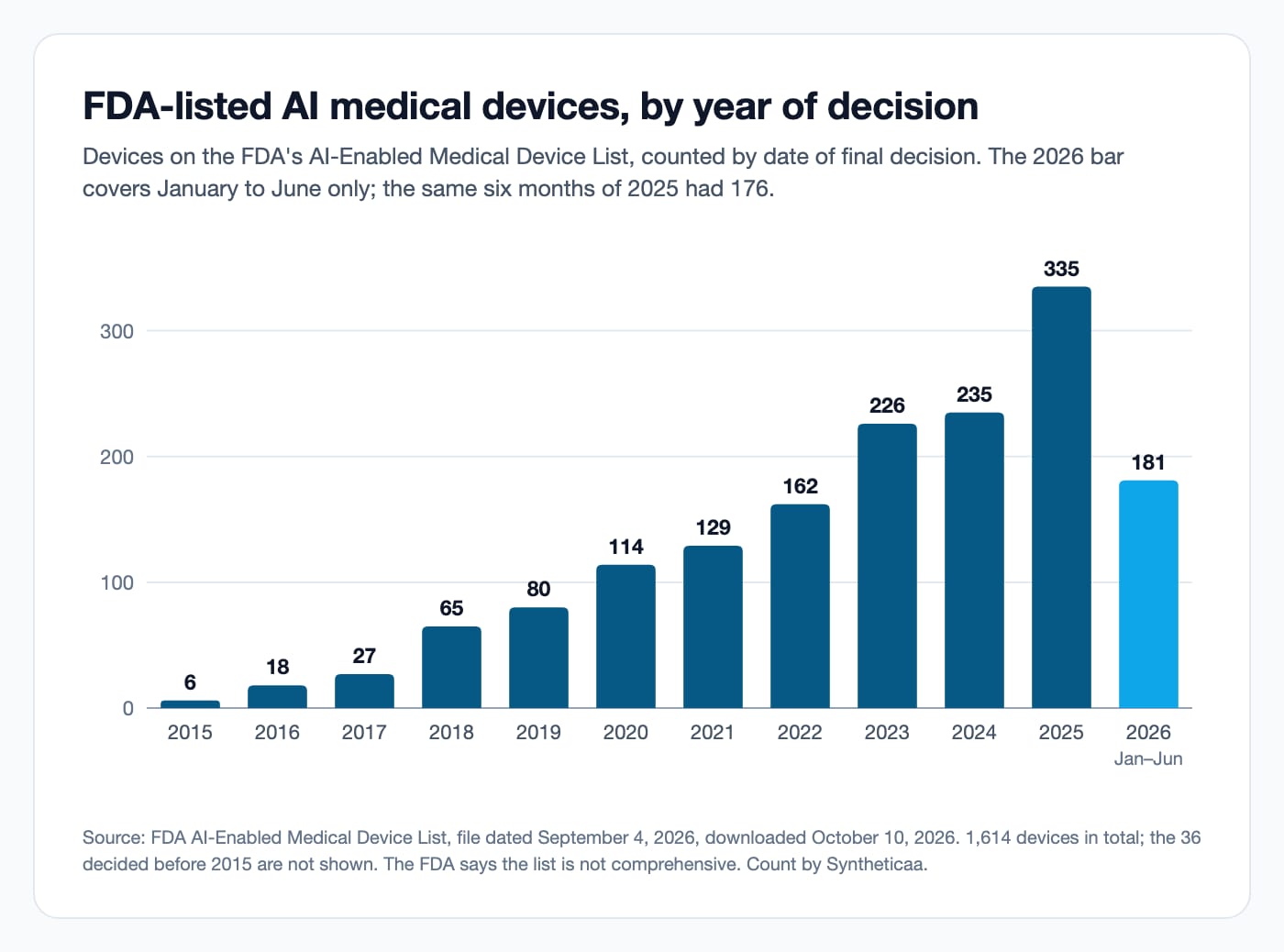
Listings have risen every year since 2015. There were 335 in 2025, and 181 in the first half of 2026 against 176 in the same months of 2025.
Two cautions apply. The FDA says the list "is not a comprehensive resource", because it finds devices mainly through AI-related terms in their public summaries. The list also does not yet show which devices use large language models. The FDA says it "will explore methods to identify and tag" them in a future update.
Scribes are largely absent from this picture. A search of the FDA file for the scribe vendors named in this article found no scribe product; the only match was a Microsoft radiology app from 2017. US law excludes software that serves as electronic patient records from the device definition under conditions that include not being intended to interpret or analyze those records for diagnosis or treatment. Whether a given scribe fits that exclusion depends on what it is built to do.
In Europe, the AI Act treats AI in regulated products as high-risk, and Annex I of the Act lists the medical device regulation among them. The EU agreed in 2026 to delay those duties to August 2, 2028, and Parliament and Council approved the change in June.
FAQ
Will AI replace doctors?
Not on current evidence. The most common uses are administrative, and only 17% of physicians in the AMA's 2026 survey used AI for assistive diagnosis. In the trials above, AI worked alongside clinicians. In the Swedish mammography trial, a radiologist still read every exam.
How many AI medical devices has the FDA authorized?
The FDA's AI-Enabled Medical Device List contained 1,614 devices when counted on October 10, 2026, covering decisions up to June 29, 2026. About 76% are radiology devices. The FDA says the list is not comprehensive, so the true number may be higher.
What is the most common use of AI in healthcare?
For physicians, it is summarizing medical research and standards of care, used by 39% in the AMA's 2026 survey. Drafting discharge instructions, care plans and notes follows at 30%. By spending, ambient clinical documentation leads at an estimated $600 million in 2025.
Is AI in healthcare regulated?
Partly. In the US, AI that diagnoses or guides treatment is generally reviewed by the FDA as a medical device, and patient data handled for providers falls under HIPAA. Billing, claims and scheduling software is not a device. In the EU, AI in medical devices is generally classed as high-risk, with duties applying from August 2028.
How these figures were checked
The FDA counts come from the CSV file on the agency's list page, dated September 4, 2026 and downloaded on October 10, 2026. We counted rows by year of final decision, by lead review panel and by submission number prefix: K for 510(k), DEN for De Novo and P for premarket approval. Four of the 21 premarket approval entries are supplements to earlier approvals.
Survey, spending and trial figures are taken from the linked reports and papers. Prices come from vendor pages on the same date, and the worked cost example covers license fees only. Most of the evidence is from the United States. The mammography trial is Swedish, the chatbot study British and the colonoscopy study Polish.
The bottom line
AI in healthcare in 2026 is mostly a documentation and billing technology, with a smaller and heavily regulated imaging business attached. The adoption numbers are real. So is the distance between them and the measured benefit: 16 minutes per eight hours of scheduled care, no significant change in after-hours work, and tools that have not always held up under independent testing.
Before trusting any figure about medical AI, ask who measured it, on whom, and against what. The rest of our technology coverage applies the same test to other AI tools.
Supun Bandara is a data analyst who writes about AI tools and technology from primary sources, and is not a clinician.
Keep reading

Conversational AI for customer service in 2026
Conversational AI for customer service explained: how it works, what Fin, Zendesk and Agentforce charge, and where it still fails. Compare the costs.
Supun BandaraSeptember 28, 202615 min read

AI coding assistant pricing compared in 2026
AI coding assistant pricing compared for 2026: Copilot, Cursor, Claude Code and Codex, with what each plan's included usage is actually worth in dollars.
Supun BandaraSeptember 4, 202610 min read
Password Managers: Are They Safe in 2026?
Are password managers safe? What the LastPass breach really exposed, the settings that decide whether your vault holds, and where passkeys fit in 2026.
Supun BandaraSeptember 3, 202611 min read