Donate Real Estate: The 2026 Tax Math
Donating real estate to charity in 2026: what an appraisal costs you, the 30% AGI limit, and the new 0.5% floor that hits property gifts first.
By Supun Bandara · September 7, 2026 · 12 min read

What Donating Real Estate Actually Involves
When you donate real estate, you sign the deed over to a charity, the charity usually sells the property, and you claim a deduction based on what the property was worth on the day you gave it away. You skip the capital gains tax you would have paid on a sale. The charity keeps the proceeds.
That is the pitch, and it is broadly true. What almost nobody tells you is the arithmetic underneath it, because almost everyone writing about this wants your property. Search for it and you will find charities, donation processors and sponsor pages, all of them warm, most of them careful to avoid a single specific number. One of the largest simply advises you to ask your tax advisor.
So here are the numbers. Three thresholds decide whether this works: whether you itemize at all, how much of your income the deduction can offset, and how much of it a new 2026 rule quietly removes before you start.
This article is general information, not tax or legal advice. Charitable gifts of real property are governed by federal rules that interact with your specific situation, and state treatment varies. Figures are current as of publication. Speak to a CPA or tax attorney before transferring a deed.
The short version
You deduct fair market value and avoid capital gains tax on the appreciation, but only if you itemize. The new deduction for non-itemizers is cash only.
Gifts of appreciated property to a public charity are capped at 30% of your adjusted gross income, with five years to use the rest.
From the 2026 tax year, the first 0.5% of your income in charitable giving is not deductible at all, and property gifts are near the front of the queue that absorbs it.
Anything over $5,000 needs a qualified appraisal. That is your cost, and it is due whether or not the gift completes.
The Four Ways to Give Property Away
Handing over the deed outright is the simplest route, not the only one, and not always the best one.
Structure | What you give up | What you get back | Suits |
|---|---|---|---|
Outright gift | The whole property, now | Full fair market value deduction | Clear title, no mortgage, no ongoing need for the asset |
Bargain sale | The property, at a below-market price | Cash plus a deduction on the gift portion | Owners who need some liquidity out of it |
Retained life estate | Ownership, but not occupancy | Deduction now, you keep living there | A primary residence you do not want to leave |
Trust or fund (CRT, DAF) | The property, into a structure | Deduction plus, for a trust, an income stream | Large gifts where timing and income matter |
A bargain sale is worth understanding even if you never use one, because you can end up in a bargain sale without choosing it. If the property carries a mortgage and the charity takes it subject to that debt, the transaction splits: part gift, part sale. The debt relief counts as an amount realised, and you can owe tax on gain even though you received no cash.
A retained life estate lets you deed the house now while keeping the right to live in it for life. You take a deduction immediately, calculated on the charity's future interest rather than the full value.
Donor-advised funds and charitable remainder trusts both accept real property at many sponsors, though acceptance is case by case. Note one asymmetry before you go that route: the new deduction for people who do not itemize specifically excludes donor-advised funds, supporting organisations and private foundations.
What You Can Actually Deduct
The deduction is capped as a share of your adjusted gross income, and the cap depends on what you give and who receives it.
Gift | Annual limit |
|---|---|
Appreciated property to a public charity | 30% of AGI |
Appreciated property to a private foundation | 20% of AGI |
Same gift, electing cost basis instead of market value | 50% of AGI |
Cash to a public charity | 60% of AGI |
Anything above the limit | Carries forward five years |
That third row is a real decision, not a footnote. You can elect to deduct your cost basis rather than market value, which lowers the deduction but raises the ceiling from 30% to 50% of income. On a property bought long ago and worth far more now, the market value route almost always wins. On one bought recently that has barely moved, the higher ceiling can get the whole deduction used in one year instead of dribbling out over six.
Run the five year carryforward before you assume a large gift pays off. Someone with $150,000 of income giving away a $400,000 building can use $45,000 in year one. Six years later, with the carryforward expired, a meaningful slice of that deduction may never have been claimed at all.
Here is the whole calculation on one set of numbers. Take a rental bought for $120,000 twenty years ago, now appraised at $400,000, with $60,000 of depreciation claimed along the way, owned by a household with $150,000 of adjusted gross income who itemize.
Step | Amount |
|---|---|
Appraised fair market value | $400,000 |
Less depreciation recapture | $60,000 |
Deductible gift value | $340,000 |
Annual ceiling (30% of $150,000) | $45,000 |
Less the 2026 floor (0.5% of $150,000) | $750 |
Deductible in year one | $44,250 |
Usable across six years at this income | about $269,000 |
Deduction that expires unused | about $71,000 |
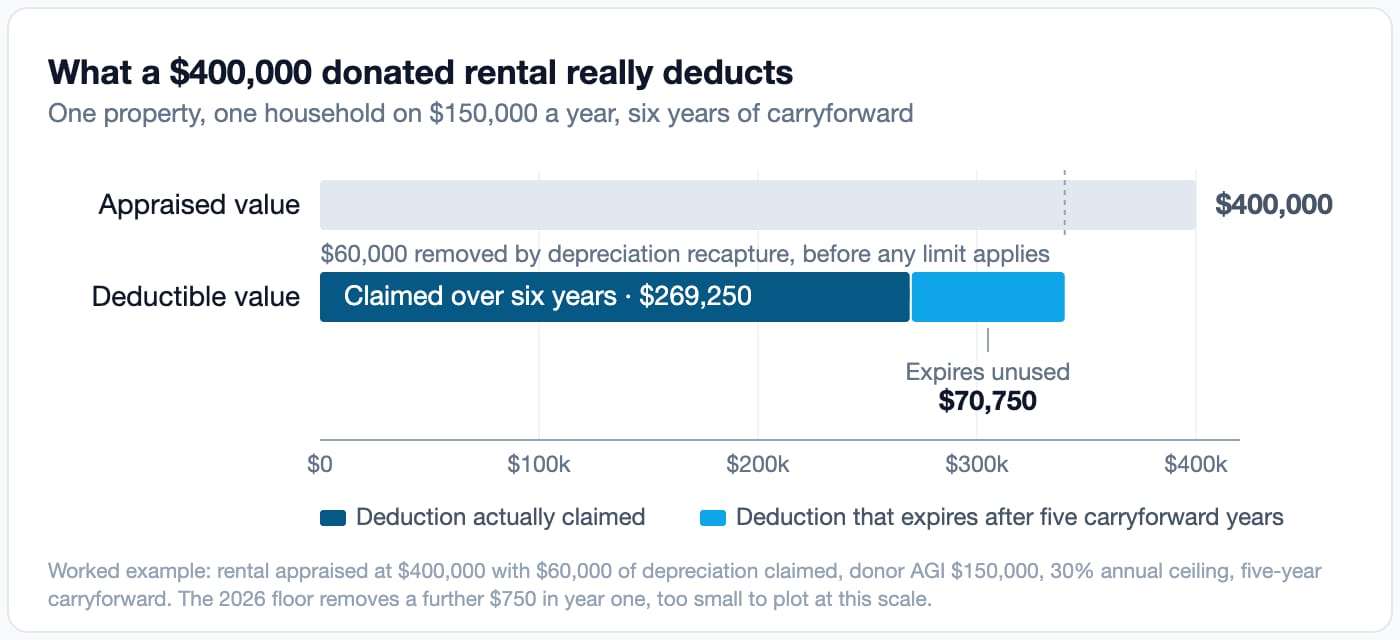
Two things stand out. The recapture adjustment removed $60,000 before the ceiling was even applied, and roughly a fifth of what remained expires unclaimed because the income was never large enough to absorb it. The tax avoided on the $340,000 of gain a sale would have triggered, including that $60,000 of recapture, is still the bigger prize here, and it is the figure worth comparing against a straight sale. But a headline of "deduct $400,000" describes almost nobody's actual return.
What Changed on 1 January 2026
This is the part every other page on the subject is missing, and it is not a small adjustment.
For tax years beginning after 31 December 2025, the One Big Beautiful Bill Act imposes a floor on itemized charitable deductions. Contributions are deductible only to the extent they exceed 0.5% of your contribution base, which is essentially adjusted gross income (Greenberg Traurig). On $400,000 of income, the first $2,000 of everything you give is simply not deductible.
On a large property gift, $2,000 sounds like rounding. The detail that matters is which giving the floor eats first.
The floor is applied against contribution types in a set order: capital gain property to private foundations, then capital gain property to public charities, then other private foundation gifts, then conservation easements, then other public charity gifts, and cash to public charities last. A donated house or parcel of land is capital gain property. It sits near the front of that queue, which means your property gift absorbs the non-deductible slice before your regular cash giving does. If you were assuming the floor would come out of your weekly collection plate donations, it will not. It comes out of the deed.
Two more changes land at the same time:
A 35% benefit cap. Taxpayers in the top bracket now get a maximum of 35 cents of deduction benefit per dollar donated, down from 37 cents. Highest earners, smallest return per dollar.
A deduction for non-itemizers that will not help you. From 2026 you can deduct up to $1,000 ($2,000 filing jointly) without itemizing. It applies to cash contributions only, and excludes donor-advised funds, supporting organisations and private foundations (Taft). A donated building qualifies for none of it.
Which leads to the question to settle before any of the rest: do you itemize? Against a large standard deduction, many households do not. A property donation is worth nothing on your return unless the deduction plus your other itemized deductions clears that threshold. Answer this first, because if the answer is no, the appraisal fee below is money spent for a tax benefit you cannot claim.
The Appraisal Is Not Optional
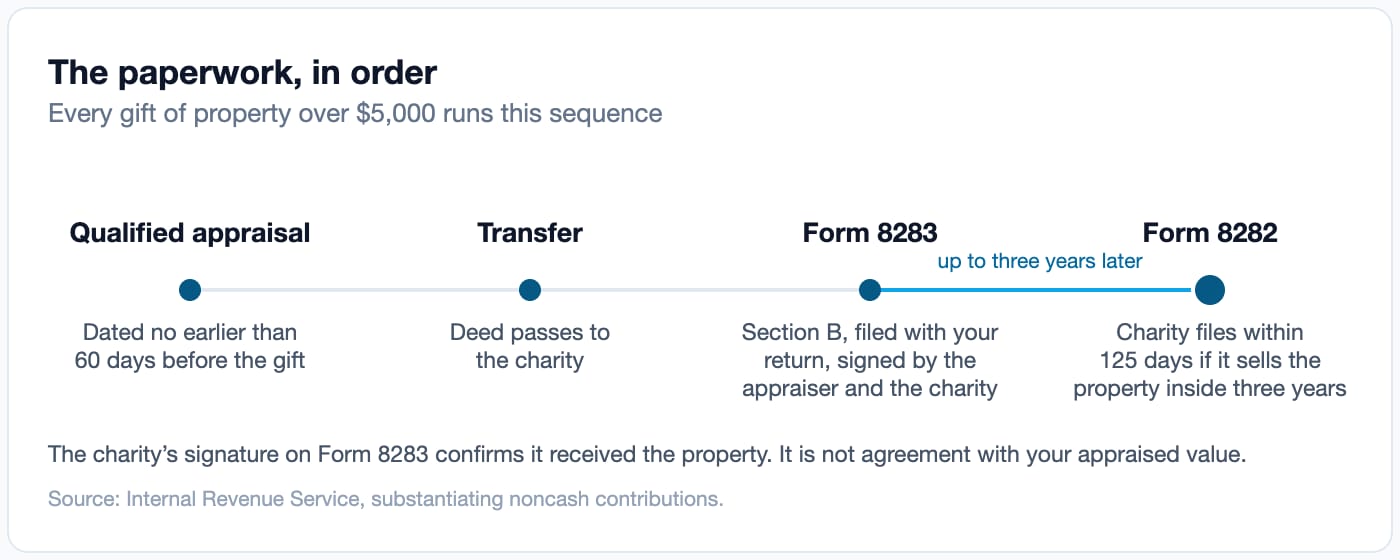
Any noncash gift over $5,000 requires a qualified appraisal, and the paperwork is stricter than most donors expect (IRS).
Timing. The appraisal cannot be dated earlier than 60 days before the donation, and must be obtained by the due date of the return claiming it.
Who can do it. Not the charity. The receiving organisation cannot serve as your appraiser.
Form 8283, Section B. Attached to your return, signed by the appraiser and by an authorised officer of the charity.
What that signature means. The charity's signature acknowledges receipt of the property and confirms it knows its own reporting obligations. It explicitly does not represent agreement with the appraised value. Donors read a countersigned 8283 as official blessing of their number. It is not.
Form 8282. If the charity sells or otherwise disposes of the property within three years, it must file this form within 125 days, reporting what it got. Exempt if the property was valued at $500 or less, or was distributed for charitable purposes.
That last one deserves a moment. Most charities sell donated real estate quickly, so within months of your filing, the IRS holds two figures side by side: your appraised value, and the price the charity accepted. A defensible appraisal is worth paying for. Expect to pay it yourself, and expect to pay it whether or not the transfer completes.
Where the Deduction Shrinks
Fair market value is the starting point, not the guaranteed outcome. Four situations cut it down.
Depreciation on a rental. If you have been depreciating the property, the deduction is reduced by the portion that would have been taxed as ordinary income on a sale. Landlords tend to be the most enthusiastic candidates for this strategy and the most surprised by this rule.
A mortgage. Debt turns the gift into a bargain sale, with taxable gain attached. Many charities will simply decline encumbered property rather than deal with it.
Short holding period. Property held a year or less is treated as ordinary income property, and the deduction drops to your cost basis.
Giving to a private foundation. The ceiling falls from 30% to 20% of income, and the floor's ordering rule hits foundation gifts of capital gain property first of all.
When the Charity Says No
Donors tend to assume the offer of a free building is unrefusable. In practice, gift acceptance committees turn down real estate regularly, for reasons that have nothing to do with gratitude.
Environmental exposure. Land, farms and commercial sites often need a Phase I assessment first. An owner in the chain of title can inherit contamination liability, and no charity wants that.
Title problems. Liens, easements, boundary disputes, unresolved probate. Anything that stops a clean sale stops the gift.
Carrying costs. Between acceptance and sale, someone pays the taxes, the insurance and the maintenance. A remote parcel that takes two years to sell can cost a small charity more than it eventually raises. That calculation has grown harder where insurers are withdrawing from higher risk areas and cover is expensive or unavailable.
Illiquidity. Rural land with no comparable sales is the classic hard case: genuinely valuable, practically unsellable.
Ask for the organisation's gift acceptance policy early. It is the fastest way to find out whether you have a donation or a project.
FAQ
Can I donate a property that still has a mortgage?
Sometimes, but it stops being a simple gift. Debt relief is treated as an amount realised, so the transaction becomes part sale and part gift and can generate taxable gain. Many charities decline encumbered property outright. Paying the loan off first, where possible, keeps the arithmetic clean.
Do I have to itemize to benefit?
Yes. The above-the-line deduction introduced for 2026 covers cash contributions only, up to $1,000 or $2,000 jointly, and excludes donor-advised funds and private foundations. A gift of property is deductible only as an itemized deduction.
How long does the process take?
Charities that handle property regularly quote three to six weeks on a clean title with paperwork in order. Add time for the appraisal, for due diligence, and considerably more for land needing an environmental assessment.
What if the charity sells for less than my appraisal?
It files Form 8282 within 125 days if the sale falls inside three years, and the IRS sees both figures. A gap does not automatically invalidate your deduction, since appraised value and a quick sale price are different things, but it invites scrutiny. This is the reason to hire a credentialed appraiser rather than the cheapest one.
Is donating better than selling and giving the cash?
It depends on your basis. On a highly appreciated property, donating avoids capital gains tax entirely and deducts the full market value, which is usually the stronger result. On property worth roughly what you paid, selling and donating cash is often simpler, gets you the 60% ceiling instead of 30%, and skips the appraisal.
The Bottom Line
Donating real estate rewards a narrow set of circumstances: property that has appreciated substantially, carries no debt, has clean title, will actually sell, and belongs to someone who itemizes and has enough income to use a deduction capped at 30% of it. Where all of that holds, the tax saving is real and the capital gains avoided are the largest part of it.
Miss any one of those conditions and the maths turns quickly. A mortgaged property creates taxable gain. A depreciated rental deducts at less than market value. A household taking the standard deduction gets nothing at all, after paying for an appraisal to find out. And from this year, whatever you give, the first half a percent of your income comes off the property gift before it touches anything else you donate.
Get the appraisal quote and the charity's gift acceptance policy before you commit to either. Both are cheap, and both will tell you within a week whether this is worth pursuing. If you are working through what happens to property and possessions more broadly, our guide to what happens to your accounts when you die covers the estate side, and there are more guides in Personal Finance.
Keep reading

Why Identical Index Funds Perform Differently
Two index funds can track the same index and return different amounts. Fees, domicile, withholding tax and replication method explain most of the gap.
Supun BandaraSeptember 5, 20269 min read

Warm Home Discount 2026/27: UK
The Warm Home Discount is £150 off your winter electricity bill, and 2.7 million more UK homes now qualify. Here are the key 2026/27 rules, dates and deadlines.
Supun BandaraSeptember 2, 20268 min read

Balance Transfer Credit Cards: Are They Worth It in 2026?
Balance transfer credit cards promise months of 0% interest on your existing debt. Here's how they actually work in the UK and US in 2026, what they really cost once fees are included, and how to tell if one is worth it for your situation.
Supun BandaraJuly 3, 20268 min read