Customer Financing Solutions: Real 2026 Costs
What customer financing solutions really cost merchants: 2%-6% per sale. Compare BNPL, third-party and in-house options, plus the July 2026 UK rules.
By Supun Bandara · September 6, 2026 · 12 min read

What Customer Financing Actually Is
Customer financing solutions let your customer pay over months while you get paid within days. A lender funds the purchase, takes a cut of the ticket, and owns the repayment relationship from there. The fee is the product: you are buying a sale that might not have happened, and the question is whether it happened often enough to cover what you paid.
That question almost never gets answered, because almost nobody publishes the numbers. Two of the largest providers in the US will not quote a rate without talking to you first. So this is a piece about the arithmetic — what the fee actually is, how much new business it needs to generate before it earns its place, and what changed on both sides of the Atlantic in the last eighteen months.
This article is general information, not financial or legal advice. Merchant terms vary by industry, volume and risk profile, and lending rules change. Confirm current terms directly with any provider before signing.
The short version
Published merchant rates run from 3.9% to about 6% of the ticket, plus a fixed per-transaction fee. Card processing sits at 2–3%.
The break-even test is one division: your financing fee divided by your gross margin gives the share of financed volume that has to be genuinely new business.
Nearly two-thirds of US buy-now-pay-later volume in 2025 carried 0% interest for the customer. Someone pays for that, and it is the merchant.
The UK started regulating third-party buy-now-pay-later on 15 July 2026. Financing you provide yourself stays outside those rules.
The Four Ways to Offer It
Every customer financing programme is one of four shapes, and they differ mainly in who absorbs the loss when the customer stops paying.
Model | Who carries the credit risk | Typical merchant fee | Best-fit ticket |
|---|---|---|---|
Point-of-sale instalment lender | The lender | 3.9%–6% + fixed fee | $500–$65,000 |
Buy now, pay later (pay in four) | The lender | ~5%–6% + fixed fee | Under $500 |
In-house financing | You | No fee, but you fund the receivable | Any, if you can wait for the cash |
Private-label card or credit line | The card issuer | Varies; often bundled with promotional periods | Repeat purchases |
Point-of-sale instalment lenders underwrite the customer in seconds at checkout and pay you shortly after the job or delivery. Wisetack, which specialises in home services, publishes a flat 3.9% per transaction on jobs between $500 and $65,000 and settles in one to three business days (Wisetack). Larger networks route one application to several lenders so a decline from the prime lender falls through to a near-prime one instead of ending the sale.
Buy now, pay later splits a small purchase into four payments over six weeks. It converts well on impulse-priced goods and badly on anything with a long consideration cycle, and it carries the highest percentage fee of the four.
In-house financing keeps the whole margin and hands you the whole problem: you are now funding a receivable, chasing late payers, and — in the US — potentially triggering state lending-licence and disclosure obligations. It suits businesses with strong cash reserves and a small, well-known customer base. It suits nobody else.
Private-label cards make sense when customers come back. The issuer runs the credit; you get a repeat-purchase instrument and a promotional 0% window to market against.
What It Actually Costs You
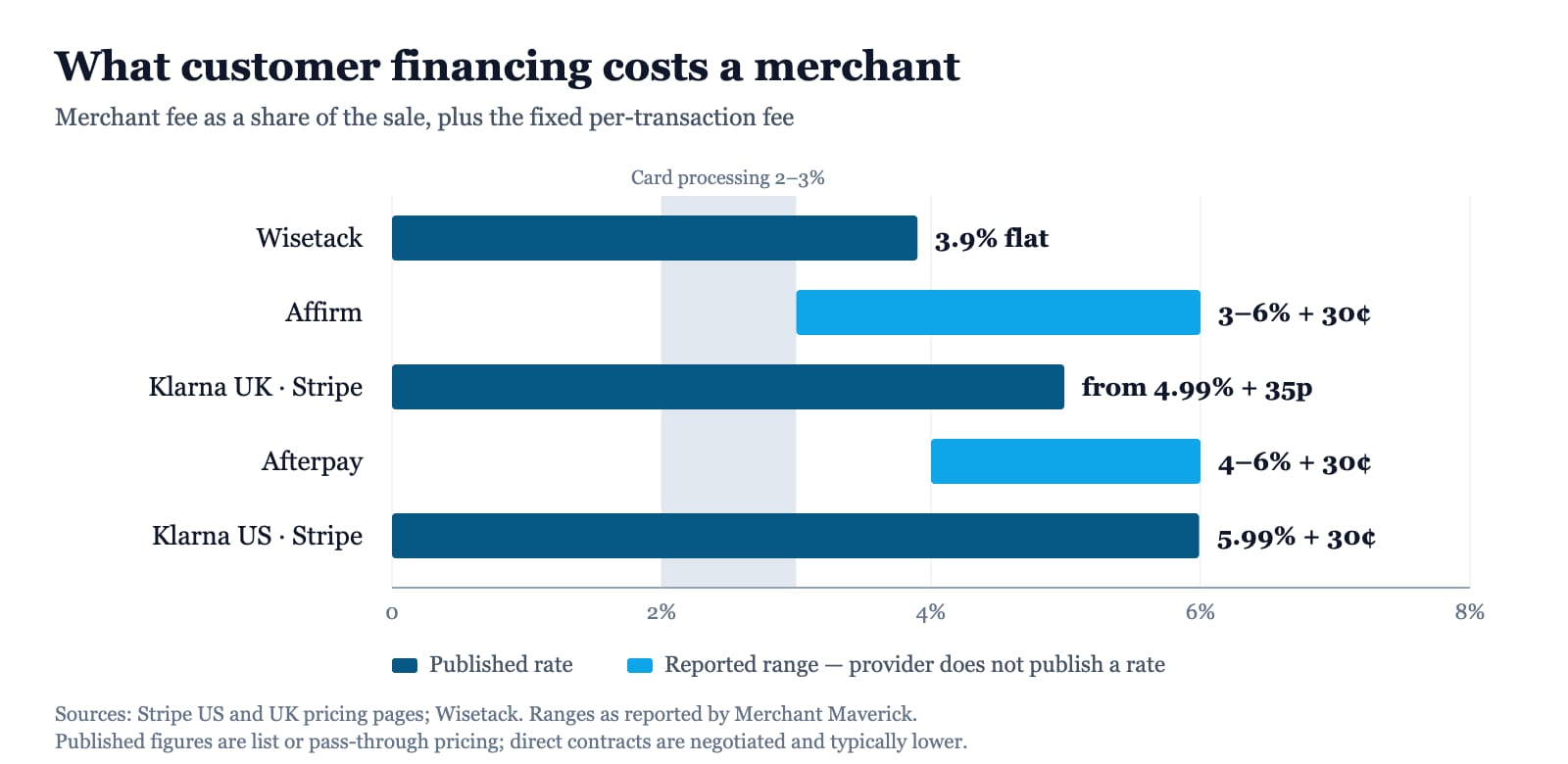
Very few providers publish a merchant rate. The ones that do, and the ones whose rates appear on a payment processor's public price list, look like this.
Provider | Merchant cost | Source |
|---|---|---|
Klarna (via Stripe, US) | 5.99% + 30¢ | Published |
Klarna (via Stripe, UK) | From 4.99% + 35p | Published |
Wisetack | 3.9% flat | Published |
Afterpay | Reported 4%–6% + 30¢ | Not published |
Affirm | Reported 3%–6% + 30¢ | Not published |
Klarna's rates come from Stripe's own price lists (Stripe US; Stripe UK). Those are pass-through prices available to anyone with a Stripe account — a ceiling, not a floor. A direct contract at volume is negotiated, and merchants report paying meaningfully less than the list rate (Merchant Maverick). If a provider will not put a number in writing before you integrate, that is information too.
For a sanity check on the whole category, the Federal Reserve's June 2026 review of the buy-now-pay-later market put merchant fees at 5–8%, against 2–3% for credit cards (Acree, Barnes, Bruce and Hannon, FEDS Notes, 5 June 2026). You are paying roughly double card processing, and the fixed per-transaction component makes small tickets disproportionately expensive: 30 cents on a $40 sale is another three quarters of a percent.
There is a reason the rate is that high. Of the $156.7 billion US providers originated in 2025, the Fed's authors found that around 63% carried no interest for the borrower. Zero-percent offers are not charity; they are merchant-funded. When a lender advertises 0% APR for 12 months at your checkout, the subsidy is coming out of your discount rate, and the promotional tiers usually price above the standard one. Read which tier your contract defaults to.
The Break-Even: One Division
Here is the calculation that no one running a financing programme seems to make.
A financed sale costs you the fee. But some of your financed volume would have happened anyway — the customer had the cash, saw the payment plan, and took it because it was there. That volume is pure cost: you paid 6% for a sale you already had. Only the genuinely incremental portion is worth anything.
So the test is: what share of financed volume must be new business for the programme to wash its face? Divide the fee by your gross margin.
Gross margin | 2% fee | 4% fee | 6% fee |
|---|---|---|---|
25% | 8% | 16% | 24% |
40% | 5% | 10% | 15% |
60% | 3.3% | 6.7% | 10% |
80% | 2.5% | 5% | 7.5% |
Read one cell. A retailer on 25% gross margin paying a 6% fee needs almost a quarter of everything that goes through the financing option to be business that would otherwise have walked. That is a demanding bar. A services business on 60% margin paying 3.9% needs about 6.5%, which is very reachable.
The pattern is blunt: customer financing is a high-margin business's tool. Thin-margin retail can still justify it, but only on baskets that genuinely do not close at full price, which usually means large tickets, not everyday ones.
Measuring the incremental share is harder than calculating the threshold, and most merchants skip it. The cheapest approximation is a holdout: turn the option off for one location, one landing page, or one week in four, and compare total revenue rather than financed revenue. If total revenue does not move, every fee you paid bought you nothing. Your accounting software should be coding those fees to their own expense line from day one, or the comparison is impossible to run later.
What Changed in the UK on 15 July 2026
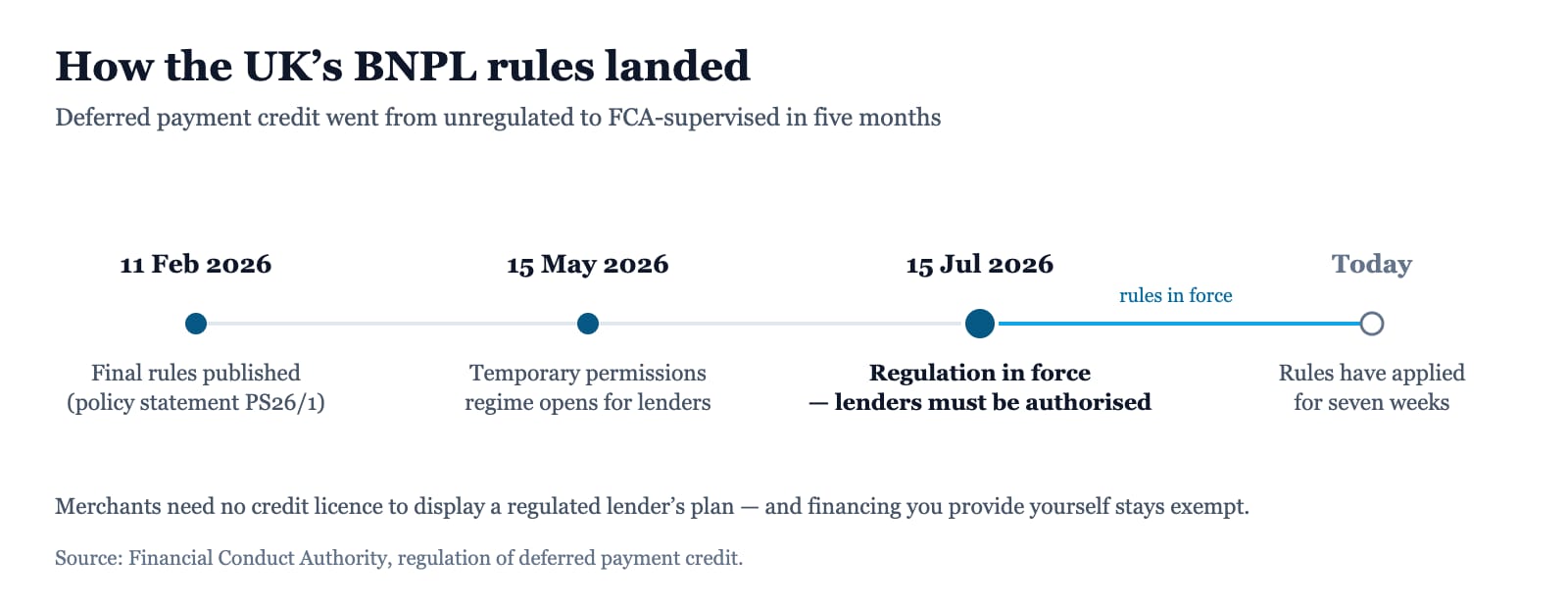
Britain's buy-now-pay-later market went from unregulated to regulated this summer. The Financial Conduct Authority began regulating deferred payment credit on 15 July 2026, following final rules published on 11 February 2026 (FCA). Lenders must now hold the relevant consumer credit permissions, run proportionate affordability checks, give borrowers clear pre-contract information, and support customers who fall behind.
The scale explains the attention. Some 10.9 million UK adults — one in five — used buy-now-pay-later in the twelve months to May 2024, and the market grew from £0.06 billion in 2017 to more than £13 billion in 2024 (FCA, 11 February 2026).
Two consequences for merchants, neither of them widely explained.
First, the obligations sit with the lender, not with you. You do not need a consumer credit licence to display a regulated lender's payment option. What you will notice is the lender pushing mandatory customer-facing information into your checkout, your app and your in-store scripts, and expecting you to display it as given. Treat it as a design constraint on your purchase flow rather than a compliance burden on your business.
Second, financing you provide yourself is still exempt. The FCA is explicit that suppliers providing their own credit remain outside the regime — the "merchant own credit" exemption was a government decision taken in 2024. In-house instalment plans therefore avoid the new rules entirely, which is a genuine advantage and also exactly why you should be careful with them: your customer gets fewer protections, and you keep every pound of the default risk.
Expect approval rates on third-party plans to soften as affordability checks bite. If your conversion model assumed the old rate, re-check it against this quarter's numbers rather than last year's. For customers on the other side of that check, the mechanics of how UK credit scoring works now matter more than they did.
Where the US Rules Stand
The American position moved in the opposite direction. In 2024 the Consumer Financial Protection Bureau issued an interpretive rule treating pay-in-four lenders as credit-card issuers under Regulation Z. On 6 May 2025 the Bureau announced it "will not prioritize enforcement actions" on that basis and signalled it would rescind the rule, which it then withdrew later that month (CFPB).
For a merchant offering a third-party plan, the practical effect is that the federal rulebook for short-term buy-now-pay-later is thinner than it was two years ago, and state law is doing more of the work.
In-house financing is the exposure that matters. Once you extend credit yourself, you can find yourself inside state lending-licence requirements and, depending on structure, federal disclosure duties — the common triggers being a finance charge or a plan running past four instalments. This is the point to spend an hour with a lawyer rather than an afternoon with a search engine. It is also worth understanding how promotional 0% offers work on the consumer side, because your customers are comparing your plan against their credit card, whether or not you are.
Questions to Ask Before You Sign
What is the approval rate for customers like mine? Ask for it by credit band, not as a blended average. A single-lender programme that declines a third of your customers at the counter is a conversion problem, not a financing solution.
Is it recourse or non-recourse? Non-recourse means the lender eats the default. Recourse means you can be charged back. Get the answer in the contract, not the sales call.
Which fee tier applies by default? Promotional 0% terms usually price above the standard rate. Know which one your checkout serves.
When do I get paid, and net of what? One to three business days is normal for the better providers. Anything longer is a working-capital cost you should price in.
Who owns the customer afterwards? Some lenders market their own app and offers to your customer for years after the sale. That is an acquisition cost you did not agree to.
What is the exit? Contract length, exclusivity clauses, and what happens to in-flight loans if you leave.
Five Mistakes That Make Financing Lose Money
Offering it on every ticket. Below a threshold, the fixed fee plus the percentage eats a small basket alive. Set a floor.
Running a single lender. Every decline is a lost sale you have already paid to acquire.
Never measuring incrementality. Without a holdout test you cannot tell a successful programme from an expensive discount.
Burying the option at checkout. Financing changes what a customer thinks they can afford, so it has to appear while they are choosing, not after they have chosen.
Advertising "0% APR" without reading who funds it. Subsidised promotional tiers are the most expensive product on the rate card.
FAQ
Does offering customer financing affect my business credit?
Third-party programmes do not lend to you, so they do not appear on your business credit file. In-house financing does affect you, because you are carrying the receivable on your own balance sheet.
Does it affect my customer's credit score?
It depends on the product. Longer instalment loans are usually reported to credit bureaus. Short pay-in-four plans historically often were not, though reporting has been expanding. In the UK, FCA-regulated lenders must now run affordability checks before approving.
What is the minimum ticket worth financing?
There is no universal figure, but the fixed per-transaction fee is what decides it: 30 cents is 0.75% of a $40 sale and 0.03% of a $1,000 one. Most merchants set a floor somewhere between $200 and $500.
Can a service business offer financing, or is it retail only?
Service businesses are among the strongest candidates. Providers serving home services underwrite jobs up to $65,000 and pay out after completion, and the higher gross margins typical of services make the break-even far easier to clear.
Do I need a licence to offer customer financing?
Not for third-party plans. In the UK the FCA regulates the lender, not the retailer displaying the option. If you extend credit yourself, the position changes and you should take advice on your state or jurisdiction.
The Bottom Line
Customer financing solutions are neither a growth hack nor a trap. They are a priced option on sales you might not otherwise make, and the price is roughly double what card processing costs you. The decision comes down to one division you can do on the back of an envelope: fee divided by gross margin gives you the share of financed volume that has to be genuinely new. If your margins are healthy and your tickets are large, that threshold is easy to clear and the programme pays for itself. If your margins are thin and your basket is small, you are most likely renting a discount you never intended to give. Run the number before you sign, then run a holdout test to find out whether the number was right. More guides for operators are in our Business section.