Collective Investment Trusts: 401(k) Fee Math
What a collective investment trust is, why it often costs less than a mutual fund, and how to find its fees in your 401(k) disclosure. Check yours.
By Supun Bandara · September 13, 2026 · 11 min read

A 401(k) fund with no ticker
Open the investment menu in a 401(k) and you may find a fund with a long name, the word "Trust" or "CIT" at the end, and no ticker symbol. You can't look it up in a brokerage app. There's no prospectus. It is very likely a collective investment trust, and there's a fair chance it's the option your contributions go into by default.
That isn't a warning sign. CITs have become one of the most common ways 401(k) money is invested, mostly because they tend to cost less than the mutual funds they replace. But they're harder to research, they're regulated by different people, and they don't come with you when you leave your job. Here's what a collective investment trust is, how it differs from a mutual fund, and how to check the one in your own plan.
What is a collective investment trust?
A collective investment trust (CIT) is a pooled fund, run by a bank or trust company, that combines money from many retirement plans into one portfolio with a single investment strategy. It's available only through certain tax-qualified retirement plans such as 401(k)s, and unlike a mutual fund it generally isn't regulated by the SEC (Investor.gov).
You'll also see it called a collective trust fund, a commingled trust or a collective fund. The idea is the same as a mutual fund: many investors share one portfolio and one set of costs. The difference is who's allowed in. A mutual fund sells to anyone. A CIT sells only to retirement plans, and your plan decides whether you get access.
The federal banking rule that governs these funds describes the retirement version as "a fund consisting solely of assets of retirement, pension, profit sharing, stock bonus or other trusts that are exempt from Federal income tax" (12 CFR 9.18).
CIT vs mutual fund: the differences that matter
Inside the portfolio, a CIT and a mutual fund with the same strategy can hold almost exactly the same investments. What differs is the wrapper around them.
| Collective investment trust | Mutual fund | |
|---|---|---|
| Run by | A bank or trust company acting as trustee | An investment company and its adviser |
| Main regulator | The OCC or state banking regulators, plus ERISA rules for the plan | The SEC |
| Who can buy | Qualified retirement plans only | Anyone |
| Offering documents | Declaration of trust and fact sheet; no prospectus | Prospectus and shareholder reports |
| Ticker symbol | Often none | Yes |
| Fee | Can be negotiated plan by plan | Set by share class, the same for every buyer |
| Can an IRA hold it? | No | Yes |
For you as a saver, three rows do most of the work. The fee row is why your employer chose the CIT. The ticker and IRA rows are why it's harder to research, and why it gets sold if you ever roll your money over.
Why CITs usually cost less
A CIT skips several expenses a mutual fund can't avoid. It doesn't register with the SEC, doesn't market itself to the public and doesn't pay retail distribution costs. It also typically holds each plan's money in a single omnibus account instead of tracking thousands of individual shareholders, which cuts administration (Mayer Brown, August 2026).
The other lever is negotiation. A mutual fund charges everyone in a share class the same rate. A CIT's fee can be agreed with each plan, so a large employer can get a lower price than a small one for the same strategy.
Asset managers say the same thing. In a Cerulli Associates survey published in June 2024, 66% named lower cost as the main benefit of offering a CIT instead of a mutual fund. Another 19% named the ability to negotiate fees (Cerulli Associates).
That second point cuts both ways. Because pricing is set plan by plan, the same CIT can cost you more at one employer than another. "It's a CIT, so it's cheap" is a reasonable starting assumption, not a fact about your plan. You have to check.
How to find your CIT's fees and returns
No ticker doesn't mean no information. Federal rules require 401(k) plans that let you choose your investments to give you the key numbers every year, in a format built for comparison. Here's where to find them.
1. Read your annual fee disclosure
At least once a year, your plan administrator must give you a chart covering every investment on the menu. The Labor Department's participant disclosure rule sets out what it must show (29 CFR 2550.404a-5):
each option's average annual total return over 1, 5 and 10 calendar years
the returns of a broad-based market index over the same periods
total annual operating expenses, as a percentage and as a dollar cost per $1,000 invested
It usually sits in your plan's online portal, under a name like "Investment Options Comparative Chart" or "Participant Fee Disclosure."
Look at three things on that chart: the expense ratio, how the 5- and 10-year returns compare with the listed index, and whether the CIT has existed long enough to show a 10-year figure at all.
Here's a sample chart laid out the way the rule requires. The fund names and numbers are invented; what matters is how you read each row.
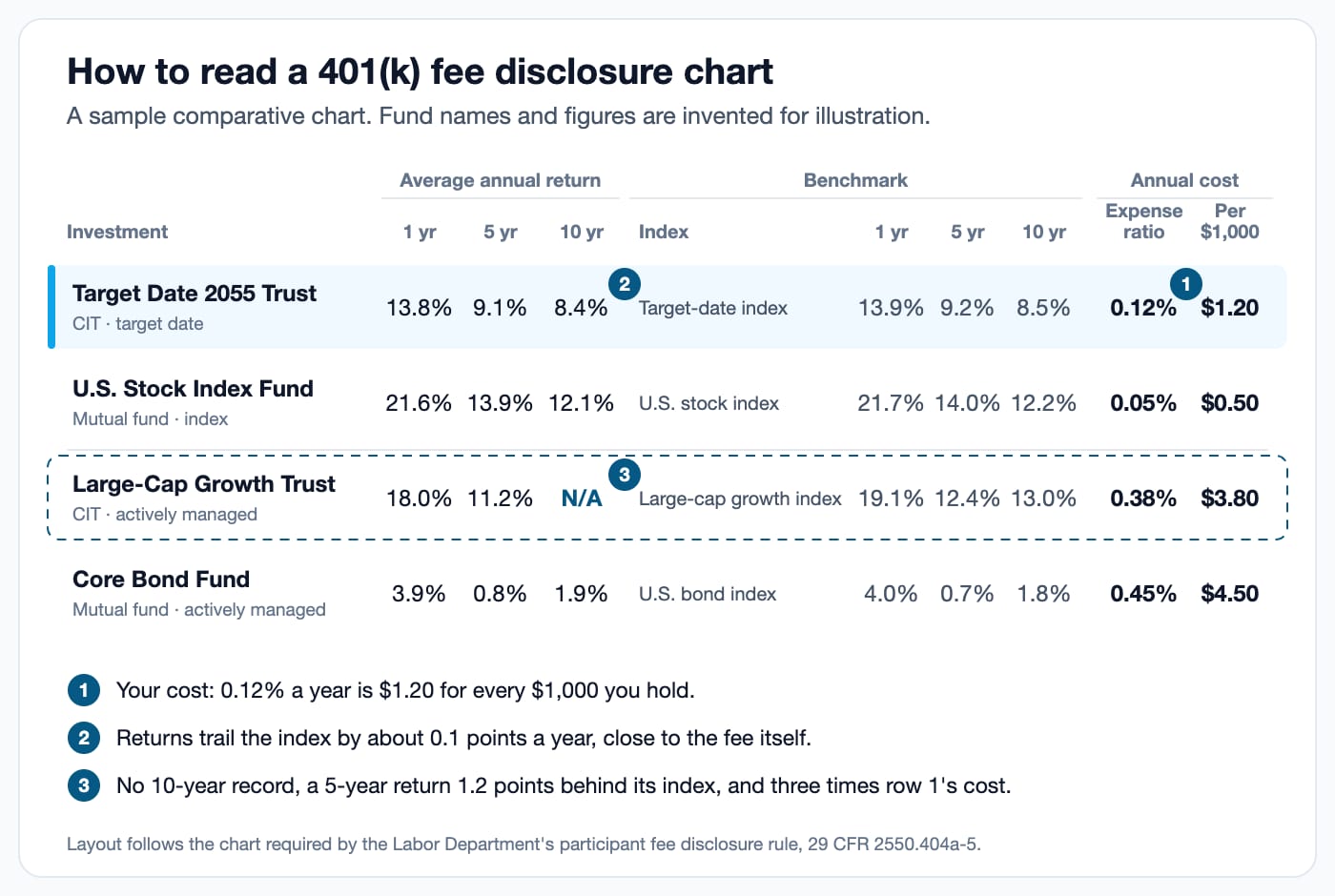
The highlighted target-date CIT charges 0.12%, or $1.20 a year for every $1,000 you hold. Its 5- and 10-year returns trail its benchmark by about 0.1 percentage points a year, close to the fee itself. Nothing there looks out of place.
The growth CIT two rows down is the one to question. It charges 0.38%, more than three times as much. Its 5-year return is 1.2 points a year behind its index, far more than its fee explains. And the "N/A" in its 10-year column means it hasn't been around long enough to judge.
2. Get the fact sheet
The same rule requires the chart to list a website with more detail on each option. For a CIT, that usually leads to a fact sheet from the trustee or your plan's recordkeeper showing the strategy, the largest holdings and the fee for your plan's unit class. Because a CIT isn't required to publish a prospectus, the fact sheet and the declaration of trust are the documents that take its place (Human Interest).
3. Compare it with a fund you can look up
Find a mutual fund or ETF that follows the same strategy. For an index CIT, that's any low-cost fund tracking the same index. For a target-date CIT, it's often the same manager's target-date mutual fund with the same year in its name. Put the expense ratios side by side and compare returns over the same periods. If the CIT costs more than a public fund doing the same job, raise it with your HR or benefits team.
When you compare returns, compare like with like. Two funds tracking one index can still post different results for reasons that have little to do with the fee, which we cover in why identical index funds perform differently.
What a small fee difference adds up to
The disclosure chart shows cost per $1,000, which makes the gap look trivial. A fund charging 0.10% costs $1 a year per $1,000. One charging 0.45% costs $4.50. What matters is what that difference does over a working life.
Here's an illustration, not a forecast. Say you invest $10,000 at the start of every year for 30 years, and the investments earn 6% a year before fees. The only thing that differs between the two funds is the expense ratio, which is deducted from each year's return.
| Years invested | Balance at 0.10% | Balance at 0.45% | Difference |
|---|---|---|---|
| 10 | $138,931 | $136,218 | $2,713 |
| 20 | $385,398 | $370,003 | $15,395 |
| 30 | $822,635 | $771,238 | $51,397 |
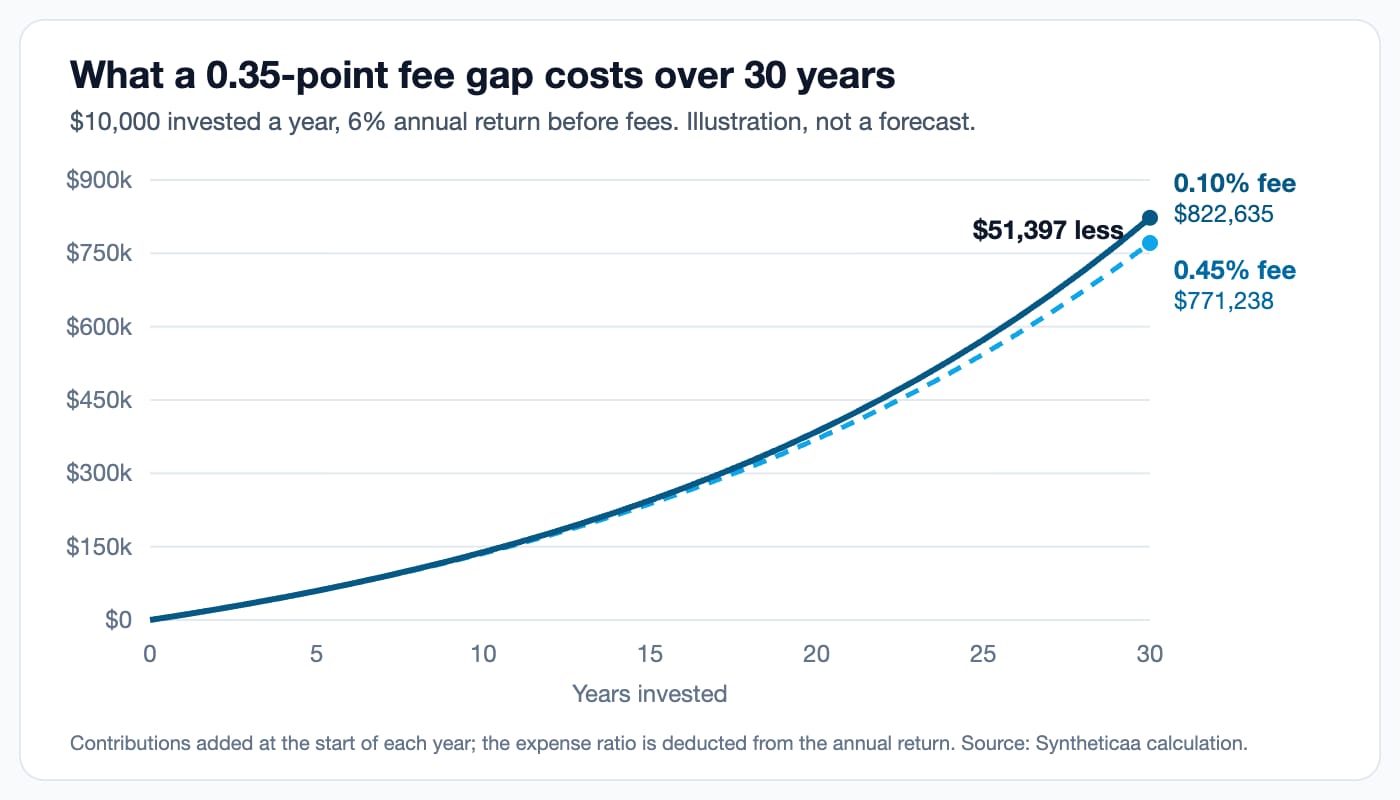
After 30 years, a 0.35 percentage point difference in fees leaves about $51,000 less, roughly 6% of the final balance. The gap barely shows for the first decade and then widens fast, because each year's fee is charged on a bigger balance, including growth that earlier fees would otherwise have left in the account.
Real returns don't arrive in a smooth 6% a year, but the shape of the result holds. That's the whole case for CITs in one number, and it's why a CIT that turns out not to be cheaper deserves a question.
Are collective investment trusts safe?
"Not regulated by the SEC" sounds alarming. It means regulated by someone else, under different rules, not unregulated.
Banking rules for the trustee. A bank running a CIT has to operate it under a written plan approved by its board and value readily marketable assets at least once every three months. It must also have the fund audited every year and provide a financial report (12 CFR 9.18). National banks answer to the Office of the Comptroller of the Currency; state-chartered trust companies answer to state regulators.
Fiduciary duties for your plan. Under ERISA, the people who choose and monitor your plan's investments owe you duties of prudence and loyalty. CITs in those plans are subject to prohibited-transaction rules and annual Form 5500 reporting (Mayer Brown).
None of that protects you from the market. A CIT's value rises and falls with what it holds, exactly like a mutual fund following the same strategy. The rules guard against the fund being run badly, not against a bad year for stocks.
The real drawbacks
Less public data. You can't pull a CIT up on a free research site the way you can a mutual fund, and the industry admits it. In the same Cerulli survey, 19% of CIT providers called the lack of clean, comparable data a significant challenge, and 75% said it was somewhat challenging.
Harder comparisons. Because fees are negotiated, figures published for one plan may not match what you pay in yours.
It stays behind when you leave. That's the next section.
What happens to a CIT when you leave your job
You can't move a CIT into an IRA. IRAs can't hold CITs, so the investment can't be transferred as it is. If you roll your 401(k) over, you'll typically need to sell your CIT units, then roll the cash into an IRA or your new employer's plan and choose new investments there (Human Interest).
That's usually a small issue. Selling inside the plan doesn't trigger tax, and a direct rollover moves the money between institutions without any tax withheld (IRS). Two steps make it smoother:
Write down what the CIT held before you leave: its strategy, its index or target year, and its expense ratio. That makes it easy to choose an equivalent public fund afterwards.
Ask for a direct rollover, so the money goes from one institution to the other instead of arriving as a check made out to you.
If your old plan lets you leave the money where it is, that's the other option. You keep the CIT and your former employer's pricing.
Why CITs took over 401(k) plans, and what's next
CITs now hold a large share of 401(k) money. Among large plans, those filing a full Form 5500 (typically 100 or more participants), the share of assets held in CITs rose from 6% in 2000 to an estimated 34% in 2023. That's according to the Investment Company Institute's analysis of Labor Department filings, which links much of the recent growth to target-date CITs (ICI, March 2026).
A legal overview published in August 2026 put CITs at more than 40% of all defined contribution plan assets and 54% of target-date fund assets (Mayer Brown).
The next step is 403(b) plans, the retirement plans used by public school teachers and many nonprofit employees, which still can't offer CITs. The SECURE 2.0 Act of 2022 changed the tax law to allow them, but the matching change to securities law didn't pass. On December 11, 2025, the House passed that change as part of H.R. 3383, and the companion Senate bill is S. 424 (Mercer).
As of July 2026 it had not passed the Senate. That month, a group of 30 retirement industry CEOs wrote to the Senate Banking Committee urging action (PLANSPONSOR). If you're in a 403(b), check the bill's page on Congress.gov for its current status.
The short version
A collective investment trust is a bank-run pooled fund sold only to retirement plans. It works like a mutual fund in a different wrapper.
CITs usually cost less because they skip SEC registration, retail marketing and distribution, and their fees can be negotiated by plan.
Cheaper is typical, not guaranteed. Check the expense ratio and the 1-, 5- and 10-year returns on your plan's annual fee disclosure, and compare them with a public fund using the same strategy.
In the example above, a 0.35-point fee gap on $10,000 a year is worth about $51,000 after 30 years.
You can't move a CIT into an IRA. Note what it held and use a direct rollover when you leave.
This article explains how CITs work; it isn't advice on your own investments. If you're weighing a rollover or a change of funds, start with your plan's disclosures, and consider a fee-only adviser for anything larger. And before putting more into retirement accounts you can't easily touch, make sure your emergency fund is the right size. More guides on decisions like this are in Personal Finance.
Keep reading

Emergency fund size: a method, not a rule
Emergency fund size is not three to six months for everyone. Use this method to work out your own number from your income, your risks and your safety net.
Supun BandaraSeptember 11, 20269 min read

How Lenders Actually Set Your Interest Rate
How lenders set your interest rate: the tiers, LTV cliffs, stress tests and portfolio quotas behind the number, and the few parts you can actually move.
Supun BandaraSeptember 10, 20269 min read

Donate Real Estate: The 2026 Tax Math
Donating real estate to charity in 2026: what an appraisal costs you, the 30% AGI limit, and the new 0.5% floor that hits property gifts first.
Supun BandaraSeptember 7, 202612 min read