Morgan & Morgan Law Firm: Fees, Reviews, Record
What Morgan & Morgan law firm charges, what client reviews and court records show, and the Florida rules that cap its fee. Read before signing.
By Supun Bandara · September 14, 2026 · 10 min read

Morgan & Morgan is the law firm behind the "For the People" billboards and TV ads. If you've been hurt in a crash or at work, its name may well be the first one you think of. This guide covers what the Morgan & Morgan law firm charges, what its clients say about it, and what its public record shows, so you can decide with the fine print in front of you.
Looking for the firm itself? Its official website is forthepeople.com. Syntheticaa isn't affiliated with Morgan & Morgan and isn't paid to recommend any law firm.
Fees: Morgan & Morgan doesn't publish a percentage. In Florida, its home state, bar rules cap the fee at 33⅓% of the first $1 million before the defendant answers, and 40% after, unless a judge approves more.
Reviews: 1.47 out of 5 on the Better Business Bureau and 1.2 out of 5 on Trustpilot, checked September 13, 2026.
Record: very large verdicts, including $425.7 million against Google as co-lead counsel, alongside 2025 sanctions against two of its lawyers over AI-fabricated citations and a 2026 arbitration award to a former client.
Before signing: get the fee at each stage, how costs are handled, and settlement approval in writing.
What is Morgan & Morgan?
Morgan & Morgan is a personal injury law firm founded in Orlando, Florida, in 1988 by John Morgan. It works mainly on contingency: you pay nothing upfront, and the firm takes a share of whatever it recovers for you. Its slogan, "The Fee is Free," refers to that arrangement (Morgan & Morgan).
It is very large. The firm says it has more than 1,000 attorneys and 140 offices, and calls itself America's largest personal injury law firm (Morgan & Morgan). Its practice areas range from car and truck crashes to slip-and-fall and workers' compensation claims, medical malpractice, defective products and class actions.
How much does Morgan & Morgan take from a settlement?
Morgan & Morgan doesn't publish a standard percentage. Its own fee guide says the fee is "a percentage of the settlement or verdict that's been agreed to in the retainer agreement." The guide adds that the fee "can vary based on location and whether or not the claim goes to trial" (Morgan & Morgan). The same guide says the percentage can fall on larger recoveries, above a threshold such as $1 million.
You'll see "33% to 40%" repeated across the web. It's a plausible range, but the pages we found repeating it don't cite a source. The number that matters is the one in your agreement.
The fee limits in Florida, the firm's home state
Florida sets maximum contingency fees for personal injury cases in its bar rules. Under Rule 4-1.5(f)(4)(B)(i) of the Rules Regulating The Florida Bar, a lawyer's fee can't exceed these percentages without a judge's approval (rule text via an unofficial copy of the Florida Bar's rule: Rule 4-1.5):
| When the case resolves | First $1 million | $1 million to $2 million | Above $2 million |
|---|---|---|---|
| Before the defendant answers or arbitration is demanded | 33⅓% | 30% | 20% |
| After an answer is filed, through trial | 40% | 30% | 20% |
| All defendants admit liability in their answer, trial only on damages | 33⅓% | 20% | 15% |
| An appeal or post-judgment action is needed | An additional 5% | ||
Florida also requires a signed Statement of Client's Rights. It gives you 3 business days to cancel a contingency fee contract, in writing, for any reason (Rule 4-1.5).
Other states set their own rules. Outside Florida, don't assume the Florida limits apply; read the percentages written into your agreement.
Where a $100,000 settlement actually goes
The percentage isn't the only thing that decides what you take home. Case costs come out too, and the firm's fee guide lists examples such as medical records, court filing fees and expert witnesses. So do any medical bills or insurer liens that have to be repaid from the settlement. And your contract says whether the fee is worked out on the full settlement or after costs are deducted.
Here's an illustration with round numbers, not figures from a real case: a $100,000 settlement, $5,000 in case costs and a $20,000 medical lien.
| Fee arrangement | Attorney fee | Case costs | Medical lien | You receive |
|---|---|---|---|---|
| 33⅓%, on the full settlement | $33,333 | $5,000 | $20,000 | $41,667 |
| 33⅓%, after costs | $31,667 | $5,000 | $20,000 | $43,333 |
| 40%, on the full settlement | $40,000 | $5,000 | $20,000 | $35,000 |
| 40%, after costs | $38,000 | $5,000 | $20,000 | $37,000 |
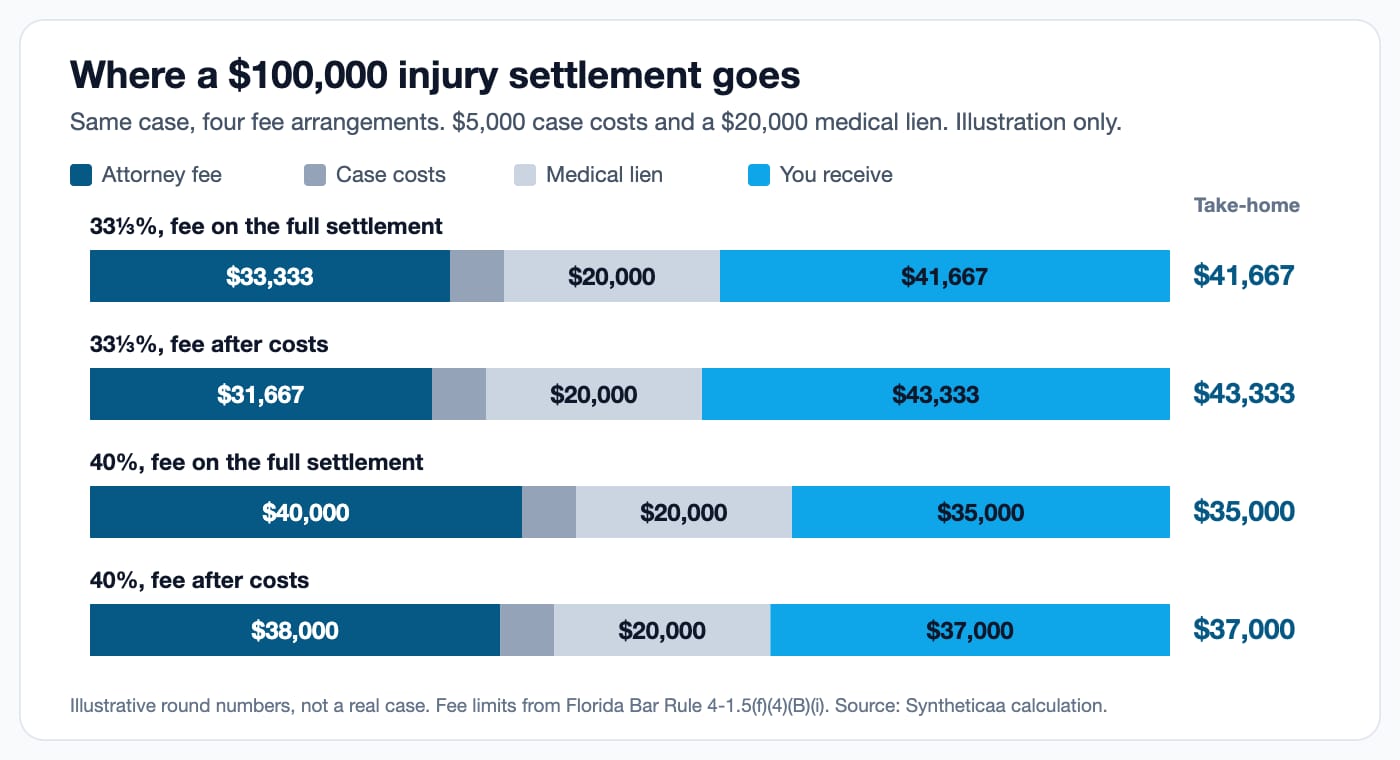
If the same case moves from the 33⅓% tier to the 40% tier, the client in this example loses about $6,300 to $6,700, depending on how the fee is calculated. How the fee is calculated is worth another $1,666 to $2,000 on its own. Neither difference shows up in an advertised percentage.
Ask about both before you sign. Also ask who pays the case costs if nothing is recovered; the firm's fee guide didn't address that when we checked on September 13, 2026.
What Morgan & Morgan reviews say
Customer-review scores for Morgan & Morgan are low on the Better Business Bureau and Trustpilot, the two review platforms we checked. Here's what they showed on September 13, 2026:
| Platform | Rating | Based on |
|---|---|---|
| Better Business Bureau | 1.47 out of 5 stars; BBB rating B; not BBB accredited | 379 customer reviews; 363 complaints closed in the past 3 years |
| Trustpilot | TrustScore 1.2 out of 5 | 265 reviews; the firm hasn't claimed the profile |
Trustpilot's automated summary of those reviews, as of September 13, 2026, highlights poor communication, unresponsive staff and cases dropped unexpectedly. We didn't combine Google reviews, which are spread across the firm's individual office listings.
Read the scores with two cautions. Complaint platforms tend to attract people who had a problem, not the ones whose case went smoothly. And a few hundred complaints over three years can't be read as a complaint rate without knowing how many clients the firm served in that time. Even so, the themes are specific, and they line up with the questions worth asking before you sign.
The court record: big verdicts, AI sanctions and a $4.3 million award
Large verdicts
Morgan & Morgan wins very large cases. On September 3, 2025, a federal jury in California awarded $425.7 million in Rodriguez v. Google, a privacy class action over data collected from users who had turned off Google's Web & App Activity setting (Bloomberg Law). Morgan & Morgan was co-lead counsel with Susman Godfrey and Boies Schiller (Susman Godfrey).
The firm says it recovered more than $6 billion for clients in 2025, including $1,098,230,342 in jury verdicts, with 295 cases taken to trial (Morgan & Morgan press release). Those are the firm's own figures, not independently audited ones.
Sanctions over AI-generated citations
In February 2025, a federal judge in Wyoming sanctioned three lawyers in Wadsworth v. Walmart, a case over a hoverboard fire, after their motions cited eight court cases that don't exist. The citations came from the firm's in-house AI tool. Morgan & Morgan attorney Rudwin Ayala was fined $3,000 and lost his permission to appear in the case. T. Michael Morgan, also of Morgan & Morgan, and local counsel Taly Goody of Goody Law Group were each fined $1,000 (LawSites).
The firm itself wasn't sanctioned. The judge noted that it had trained staff on AI use and added a requirement that users independently verify AI-generated information. The lawyers also withdrew the motions promptly and paid the other side's fees (court order).
A $4.3 million arbitration award
In July 2026, a Georgia arbitrator awarded a former client, 73-year-old Robert Wyrosdick, $4.3 million. The arbitrator found that Morgan & Morgan and one of its attorneys settled his injury case for $45,000 in early 2024 without his documented written consent. The findings were legal malpractice, breach of contract and breach of fiduciary duty, and the award included $3.15 million in punitive damages (The Atlanta Journal-Constitution).
In a statement reported by the Journal-Constitution, the firm said its attorney "received verbal client consent but then did not document it in writing." It added that it strongly disagrees with the findings but respects the process.
Pros and cons of hiring Morgan & Morgan
| Pros | Cons |
|---|---|
| Resources to take a case to trial, and a record of very large verdicts | Low customer-review scores on BBB and Trustpilot, with repeated complaints on Trustpilot about communication |
| No fee unless the firm recovers money for you | No published fee percentage; the terms are only in your agreement |
| Offices in many states; the firm reports 140 | A 2026 arbitration award over a settlement accepted without documented written consent |
| Experience across injury types, from car crashes to class actions | Two of its lawyers and their local co-counsel sanctioned in 2025 over AI-fabricated citations; the firm itself wasn't sanctioned |
Is Morgan & Morgan good? For a serious injury with clear liability, where the other side may only pay after a lawsuit, a firm with money to go to trial has real advantages. Where your case is simpler, or you want steady contact with one lawyer, the size that helps at trial can work against you day to day.
Questions to ask before you sign with any big injury firm
These apply to Morgan & Morgan and to any contingency firm. Get the answers in writing.
Which licensed attorney will handle my case, and how do I reach them directly?
What percentage applies at each stage, before a lawsuit, after one is filed and if there's an appeal?
Is the fee calculated on the full settlement or after costs?
If nothing is recovered, do I owe any case costs?
Will you settle only with my written approval? The Georgia arbitration turned on exactly this.
Who will update me, and how often?
Will you try to reduce medical liens before the settlement is split?
If you're in Florida, remember the 3-business-day window to cancel a contingency agreement in writing.
Alternatives to Morgan & Morgan
A national firm isn't the only option. A smaller local firm may give you more time with the lawyer actually handling your case, though it may have less money to fund a trial. Your state bar's lawyer referral service, where one exists, can suggest licensed lawyers near you. And it's reasonable to ask any firm whether its percentage is negotiable.
If you're still deciding whether you need a lawyer at all, start with whether you need a personal injury lawyer after a car accident. For a crash on two wheels, see which type of motorcycle accident lawyer to hire.
The bottom line
Morgan & Morgan is a very large contingency-fee injury firm. It doesn't publish its percentage; the number is in your retainer agreement.
In Florida, the fee on the first $1 million is capped at 33⅓% before the defendant answers or arbitration is demanded, and 40% after, with lower rates above $1 million, unless a judge approves more.
Whether the fee is taken before or after costs, and how medical liens are handled, can move your take-home by thousands of dollars.
Its customer-review scores are low on BBB and Trustpilot, with Trustpilot reviews centered on communication. Its record includes both huge verdicts and a 2026 award over a settlement made without documented written consent.
Ask the seven questions above, and get the answers in writing, before you sign with any firm.
Written by Supun Bandara, a data analyst, not a lawyer. Figures, ratings and rule text were checked against the linked sources on September 13, 2026. This article is reporting and analysis, not legal advice. For advice on your own case, speak to a licensed attorney in your state. More guides like this are in Legal.
Keep reading

Motorcycle Accident Lawyer: Which Type Is Best
Choosing a motorcycle accident lawyer: how local firms, regional firms, national ad firms and referral services really differ on fees and case handling.
Supun BandaraSeptember 9, 20267 min read

Family Law Digital Marketing: Costs and Rules
What family law digital marketing actually costs per signed case in the US, plus the bar advertising and FTC rules that decide which tactics you can use.
Supun BandaraSeptember 6, 202614 min read

What happens to your online accounts when you die
Your online accounts do not pass in a will like a car does. What Apple, Google and Meta actually allow, and how the law differs in the US, UK, EU and Australia.
Supun BandaraSeptember 4, 202611 min read